


Background
Scandinavians have always been
very interested in the oceans. As
far back as
the 1500s a Swedish priest, Olaus Magnus, made a famous map of the
Nordic countries called the ‘Carta Marina’, published in 1539. As
its name indicates, it also includes a tremendous amount of detail
about the ocean, not only of life in the sea, but also of whorls and
eddies between Iceland and Norway just north of the Faroes. A
copy of Carta Marina will be on display here on the Norröna
shortly. In the late 1800s Norwegian oceanographers conducted a
number of expeditions to chart the Nordic Seas. They also
developed the observational and theoretical skills to interpret their
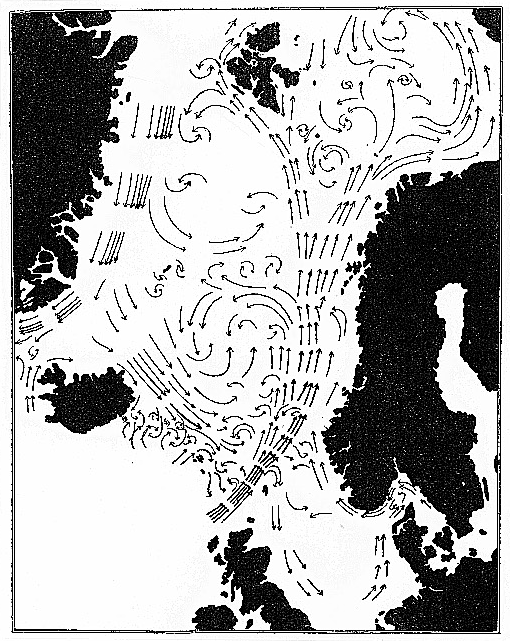
findings. The left |
figure below shows a
sketch of the surface
circulation in the
Nordic Seas, published in 1909 by Helland-Hansen and Nansen. They
clearly show flow from the Atlantic all along the
Iceland-Faroe-Scotland ridge: a rapid narrow flow west of Scotland, and
a more eddy-like pattern southeast of Iceland, not unlike what Olaus
Magnus
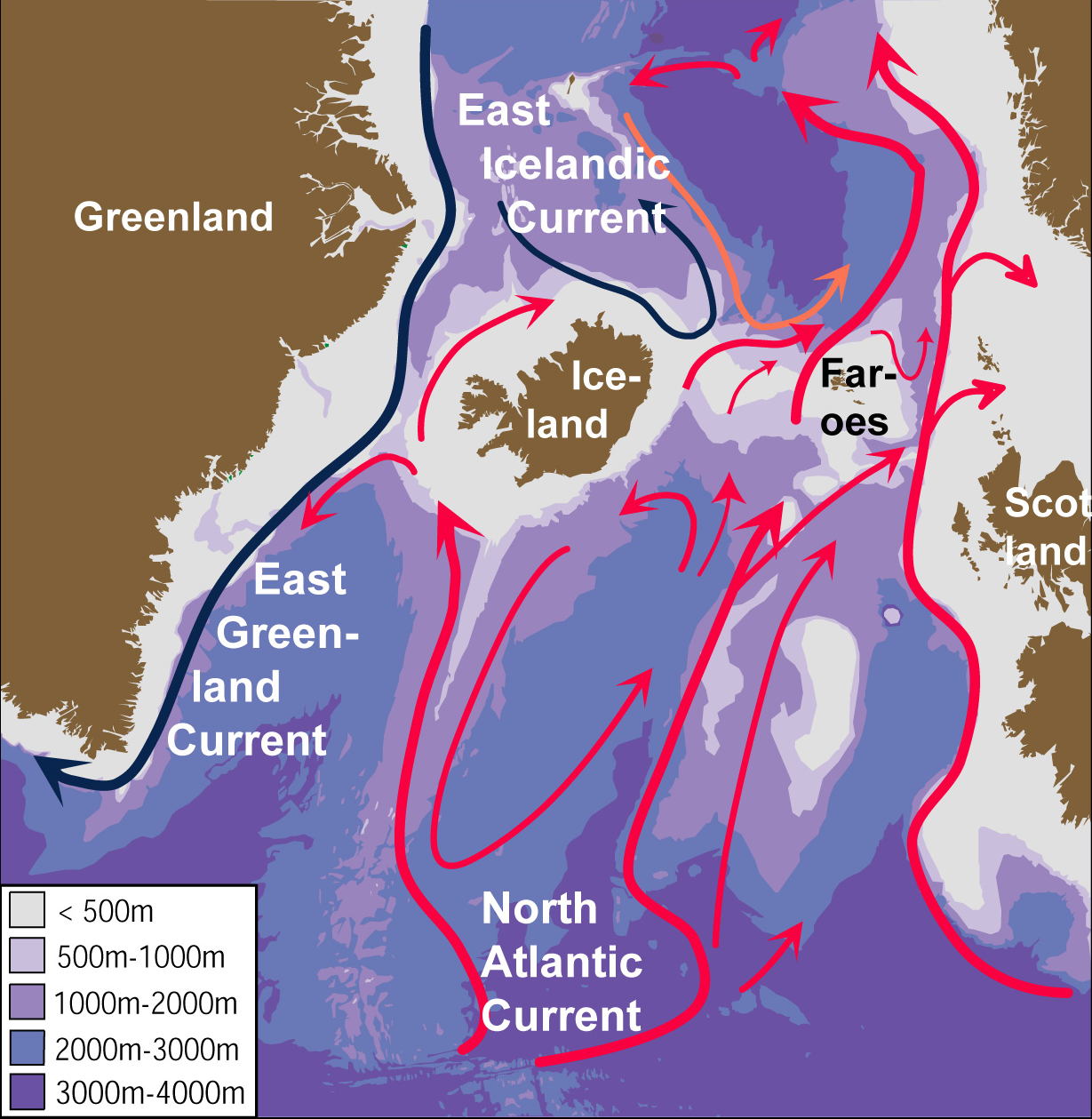
drew in Carta Marina almost 500 years earlier! Since then, a
number of studies have shown that the Iceland-Faroe inflow organizes
itself into the eastward flowing Faroe Current just north of the
Faroes. The right figure provides a schematic summary of our
present
understanding of the ocean currents in and between the northeast
Atlantic and the Nordic Seas.
|
|
|
Recent
Research
A number
of
research programs have been measuring currents in the Denmark Straits
between Greenland
and Iceland and along the ridge between Iceland, the Faroes and
Scotland. The classic measurement technique
is the moored (or anchored) recording current meter that measures the
flow of
water past the mooring and records the results internally. Such
instruments have been deployed across the Faroe Bank
Channel, located between the Faroes and Faroe Bank to the south to measure the outflow
of cold water from the Nordic Seas back into the Atlantic. (This
800 m
deep channel
is the deepest connection between the Atlantic and Nordic Seas.)
Similar instruments have been deployed across
the Shetland Channel to measure the inflow of warm waters into the Norwegian Sea, and
north of the Faroes to measure the volume of water transported by Faroe
Current.
These programs have greatly improved our knowledge of the
exchange rates and how they vary with
time, from season to season and from year to year. To date, the best
estimate
of inflow
between Iceland the Faroes is 3.8 x 10⁶ m3/sec
and just about the same amount in the Shetland
Channel. For
comparison, the outflows from all the rivers of the world sum to about
1 x 10⁶
m3/sec.
The
Norröna Project:
The Norröna measurement program takes a different approach: It
will measure currents from the surface to depths as great as ~800 m
depth all along along the ship’s track. Thanks to the twice
weekly
transits between Denmark and Iceland, throughout the year, year after
year, the inflow and how it varies in time along the ridge
|
can be determined
with unprecedented accuracy. Unlike moored current meters,
the Norröna will provide substantially improved spatial coverage.
Why does this matter?
We know that the inflow of water through the Shetland Channel varies
depending upon winds over the northeast Atlantic. We also know that a
decrease in transport cannot persist without causing the inflow to
increase elsewhere (or the outflow to decrease) for otherwise the sea
level in the Nordic Seas would likely begin to drop. By measuring
currents throughout the region, we can begin to understand in detail
how changes in one place lead to variations in another. Because
the Norröna can measure currents to ~800 m it will also be able to
measure the flow from the Nordic Seas back into the Atlantic. At depths
below the 800 m (the sill depth of the Faroe Bank Channel) there should
be little net flow south through the Shetland Channel. At shallower
depths the Norröna will be able to measure any waters going south
and eventually spilling into the deep north Atlantic. Thus the
Norröna will be able to measure flows in and out and how they vary
spatially and in relation to each other.
But the most important question the Norröna program seeks to
address is the long-term stability of the flow into the Nordic Seas of
warm salty water,
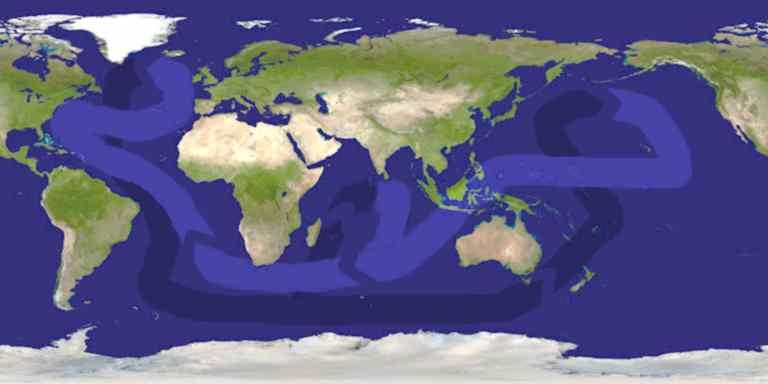
the upper branch of the global merdional ocean circulation. Some
observations have indicated a possible weakening of the MOC, but the
measurement uncertainties are huge. The complete coverage of the inflow
provided by the Norröna will allow oceanographers to determine
with significantly improved accuracy the inflow and how it varies in
time and along the
ridge. One might say that the Norröna will provide an early
warming system for any change in this inflow and thus change in
European climate.
|
The
Norröna System and Installation
The water current measurements from the Norröna make use
of a device called an acoustic Doppler current profiler, or
ADCP. The ADCP's acoustic transducer is installed on the bottom
of the ship and sends out four narrow acoustic beams down into the
water and receives back the Doppler shifted signal reflected from
plantonic particles and thermal inhomogenities in the water. The
Doppler shift of the returned signal is proportional to the water
velocity along the beam relative to the acoustic transducer. This
data incombination with the ship's compass, GPS navigation data and a little bit of
trigonometry, can convert these
velocities into estimates of the absolute water movement in terms of
its east, north and vertical components.
The
ADCP
installed on the Norröna is a 75 kHz RD
Instruments Ocean Surveyor (OS75) mounted in a void
space
between frames 105 and 106, about 60 meters
from
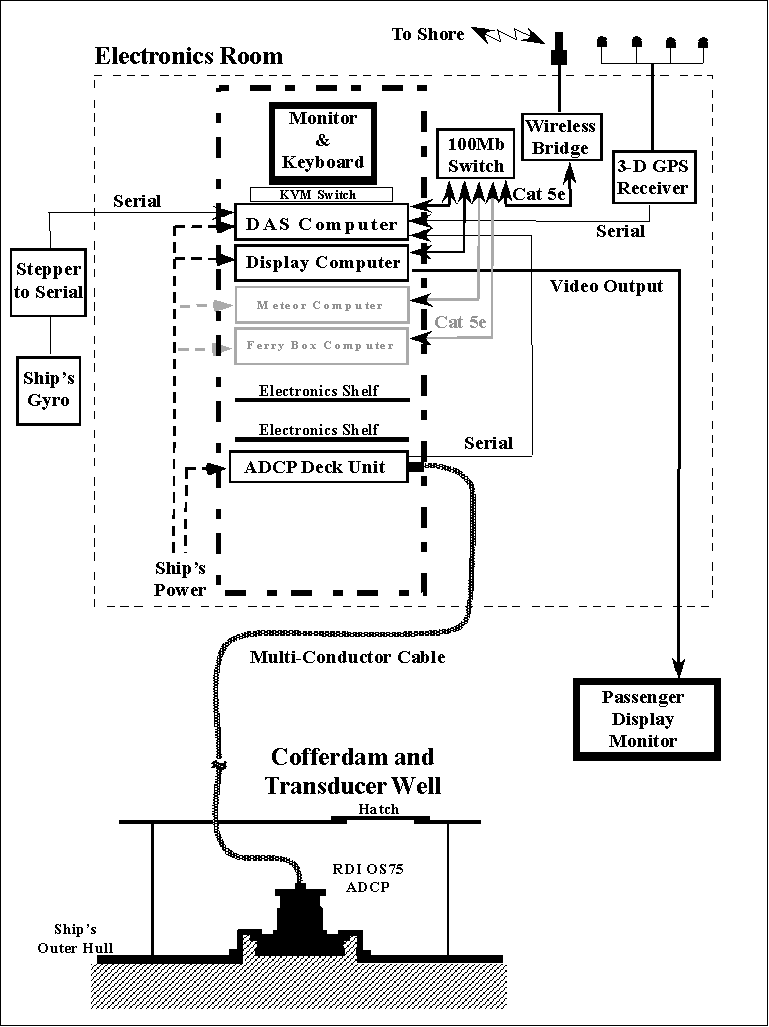
the bow (see figure below). The figure to the right (click
on thumbnail image) shows a
schematic of the entire
ADCP system from the transducer inside its "seachest" to the deck unit
and data acquisition system in one of the ship's electronics rooms on
deck 8. The "seachest" forms a water tight connection to the hull
while the cofferdam provides a secondary containment. A
multi-conductor
power and signal cable
connects the transducer to the data acquisition and archiving
system. The primary heading data is supplied from a compass
repeater tied
to the ship's gyro compass. Navigation
information is supplied from a Thales ADU5 GPS receiver which provides
very accurate
heading information as well as the ship's position. The data
collection is controlled by the AutoADCP software which, in turn,
controls and monitors RD Instruments' VMDAS data acquisition
system. When the vessel
docks in Torshavn a two-way
wireless internet connection to shore provides a means to control the
system and down-load the data.
The installation of the ADCP system on the Norröna presented some
unexpected difficulties. The initial installation took place in
January 2006 at
the Blohm and Voss shipyard in Hamburg, Germany. We have
installed and run ADCP systems on commercial and research vessels in
the
past but the Norröna
presented a number of new challenges. The first was that the ship
is actually a full-scale floating hotel with all the amenities and
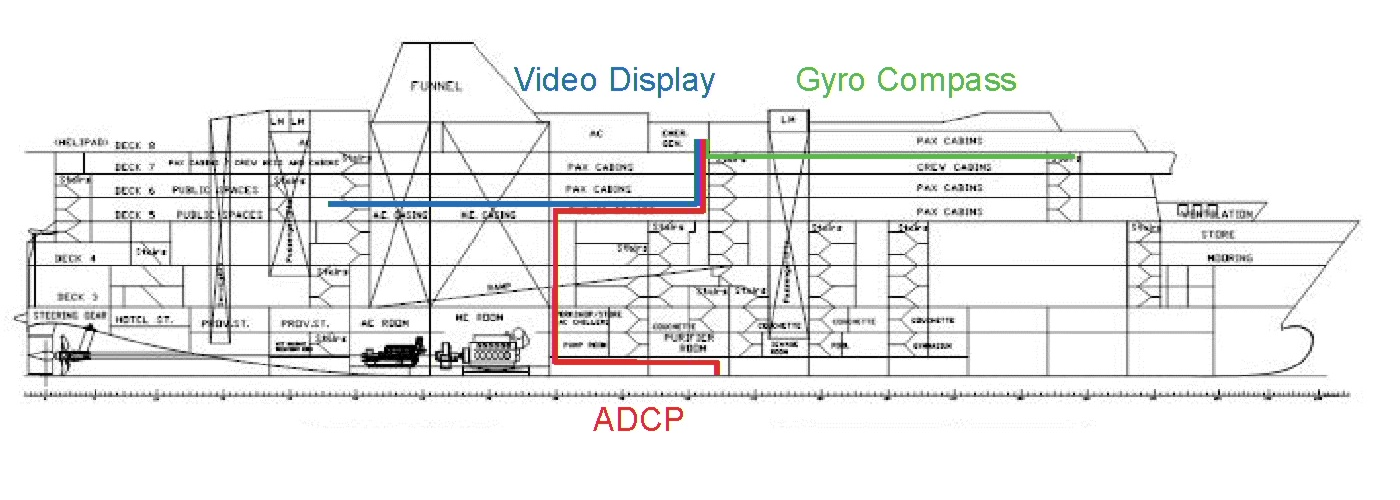
finished accommodations that one would expect. Leading several
cables (see figure below) from the top of the ship to the bottom and
from fore to aft
meant that the panelling along seeming miles of corridors had to be
carefully removed and then
reinstalled. And because we were dealing with a finished vessel,
over a dozen watertight through-bulkhead cableways needed to be opened,
the ADCP and other cables passed through, and then the pass-throughs
re-cemented.
|
|
|
Cabling for the Norrona ADCP System
 |
Bubble
Sweep-Down
Despite some surprises with the ADCP's initial installation, the
ADCP was successfully installed during the one-week dry dock
period.
It was during the shake-down cruise during the week following the
relaunching of the ship that we encountered the real
difficulties with the system although we were not sure what was
happening for some time. Various tests right after launch as well
as
later tests by an RD Instruments technician indicated that the
instrument itself
was working properly. However the data return was extremely
spotty and
poor. There were somewhat better results when the Norröna
steamed through the fjords approaching Bergen, one of the
ship's usual ports of call. But as soon as the ship passed out of
the
fjords into the open sea the backscatter amplitude became irratic, the
correlation level dropped to low levels (the OS75 is a broad-band
instrument) and the percent good went to zero. Occasionally, as
in
once every few minutes, we would get a possible profile but when the
seas got rougher even those occasional profiles ceased.
Candidate sources of our problems with the data collection included
internal machinery-generated vibration, propeller noise, electronic
interference due to the long length of cable that necessarily ran
along-side some of the ship's power cables, and the outside possibility
that we were experiencing bubble sweep-down. We talked to people
experienced in ship vibration which suggested that there would be very
little if any vibration energy in the ADCP's 75kHz frequency band even
from the extremely noisy, to our ears, centrifugal oil separators
located above and aft of the ADCP transducer. Various tests with
and without the ADCP connected and with various ship systems turned on
and off finally showed that we were not getting any electronic
interference. That left bubble sweep-down as the only reasonable
explanation for the poor rate of data return.
Bubble sweep-down, during which bubbles generated by the bow wave are
swept under the hull, is something that the US Navy has dealt with but
there does not seem to be much if any literature on how to deal with
it. The usual approach if bubble sweep-down is encountered is to
mount acoustic devices on streamline pods below the ship. On the
relatively slow vessels of the research fleet, bubble sweep-down has
sometimes been encountered in rough weather but is not usually a
problem. However in the case of the RV Iselin operated by the
University of Miami, bubble sweep-down
was shown with cameras mounted below the hull to be a significant
problem. This led to the installation of a simple pod for its
acoustic sensors which generally corrected the problem. The RV
Thomas Thompson operated by the University of Washington has a
permanent 19" deep pod in which all its acoustic
sensors are mounted. This has resulted in extremely good data
from its ADCPs even in very rough weather.
In the past, bubble sweep-down has not appeared to be a significant
issue in the voluntary observing ship programs that make use of
commercial container vessels and cruise ships. Our own experience
with
the MV Oleander, a relatively small (~400') container vessel operated
by Bermuda Conatiner Lines that makes
weekly runs between New York and Bermuda traveling at about 17kts, has
indicated that when the
ship is loaded during the Bermuda-bound legs that the data return is
usually quite acceptable. On the return New York bound leg of the
trip when the ship is lightly loaded, draws ~1m less and the bow rides
higher, it takes reasonably good weather for good data return.
The hull of container vessels, and this includes the Oleander, are
generally fairly blunt and generate a significant bow wave which one
would think would lead to major bubble sweep-down problems. But
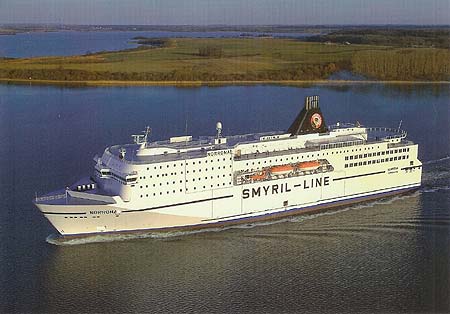
that does not appear to be the case. The Norröna runs only
somewhat faster
than the Oleander at 21kts. The hull, on
the other hand, looks similar to that of high speed cruise ships with a
sharp entry which one would normally expect to generate a
minimal bow wave and thus, minimal bubble sweep-down. In
addition, the Norröna is almost always
ballasted to maintain a constant draft, whether it is empty or
full. One potential source of the bubbles is that the
Norröna has two
enormous
bow-thrusters located just below the waterline (see the photo below)
which could draw in bubbles when the ship pitches. Another
possiblity brought to our attention after consultations with naval
architects familiar with high speed ferry design
and their bulbous bows is that the sharp intersection between the
bulbous bbow and the hull creates a potential pathway for bubbles to
get under the hull.
Evolution of the Bubble Fairing
With the painful conclusion that bubbles were all but completely
blanking out the ADCP we were left with two choices. Either
remove the ADCP and give up on the scientifically ideal route between
Europe and Iceland, or try to come up with a viable solution. We
chose to try to save the installation and the route by investigating
the feasibility of installing a fairing. And rather to our
surprise, Smyril Line was willing to go along with this approach.
For those who are unfamiliar with commercail ship design, virtually all
commercial vessels are falt-bottomed over most of the hull with no keel
projecting down. Thus, any fairing we might install would be the
deepest and most exposed portion of the hull.
The first item of business was to find out whether a fairing would do
any good at all. Luckily for us, the Norröna was
scheduled for a dry dock period in May 2006 which afforded us an
opportunity to attach a temporary fairing. By temporary we mean
that it was expected that at some point the fairing would fall off
either through finally yielding to the flow past the device or because
the unit was bumped while maneuvring in the shallow waters of the ports
of call. Given the lack of any references on fairing design
the sizing of the fairing was a somewhat arbitrary
exercise. We made the assumption that the bubbles would be
contained in the turbulent boundary layer running along the
bottom. The boundary layer thickness was estimated to be about 15
cm thick at the location of the transducer so a fairing about 20 cm
tall with a suitable lip should penetrate the boundary layer and push
the
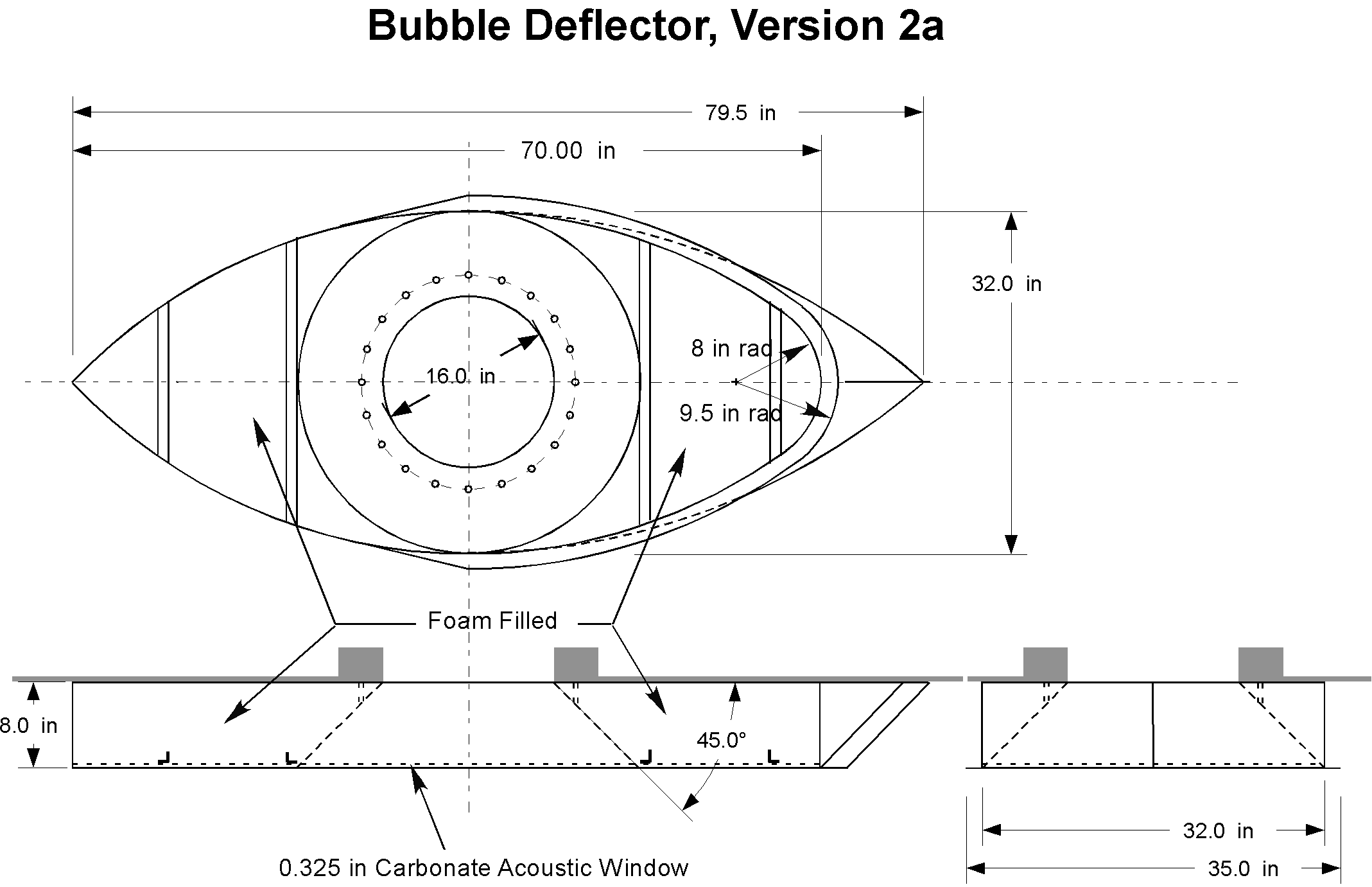
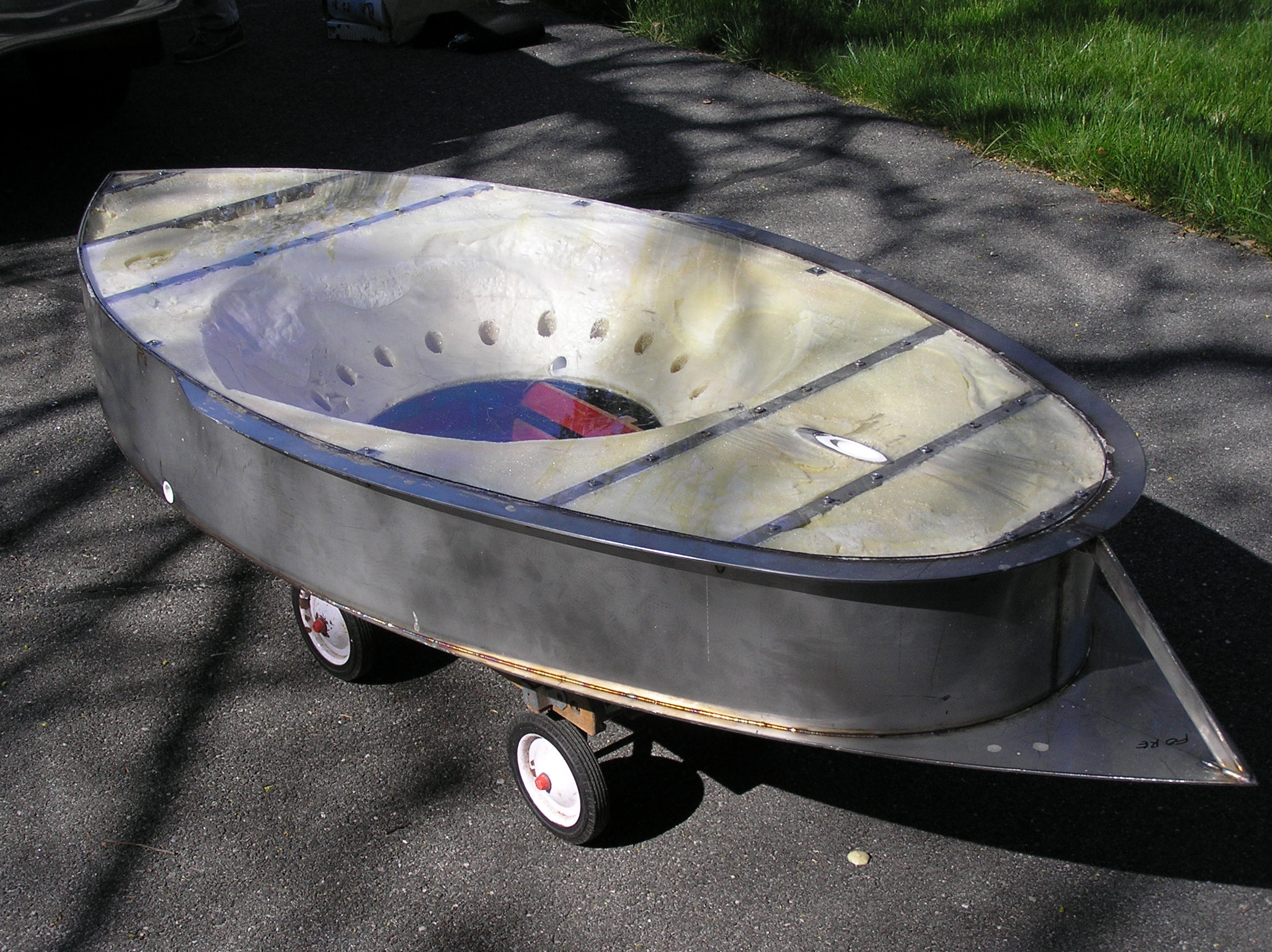
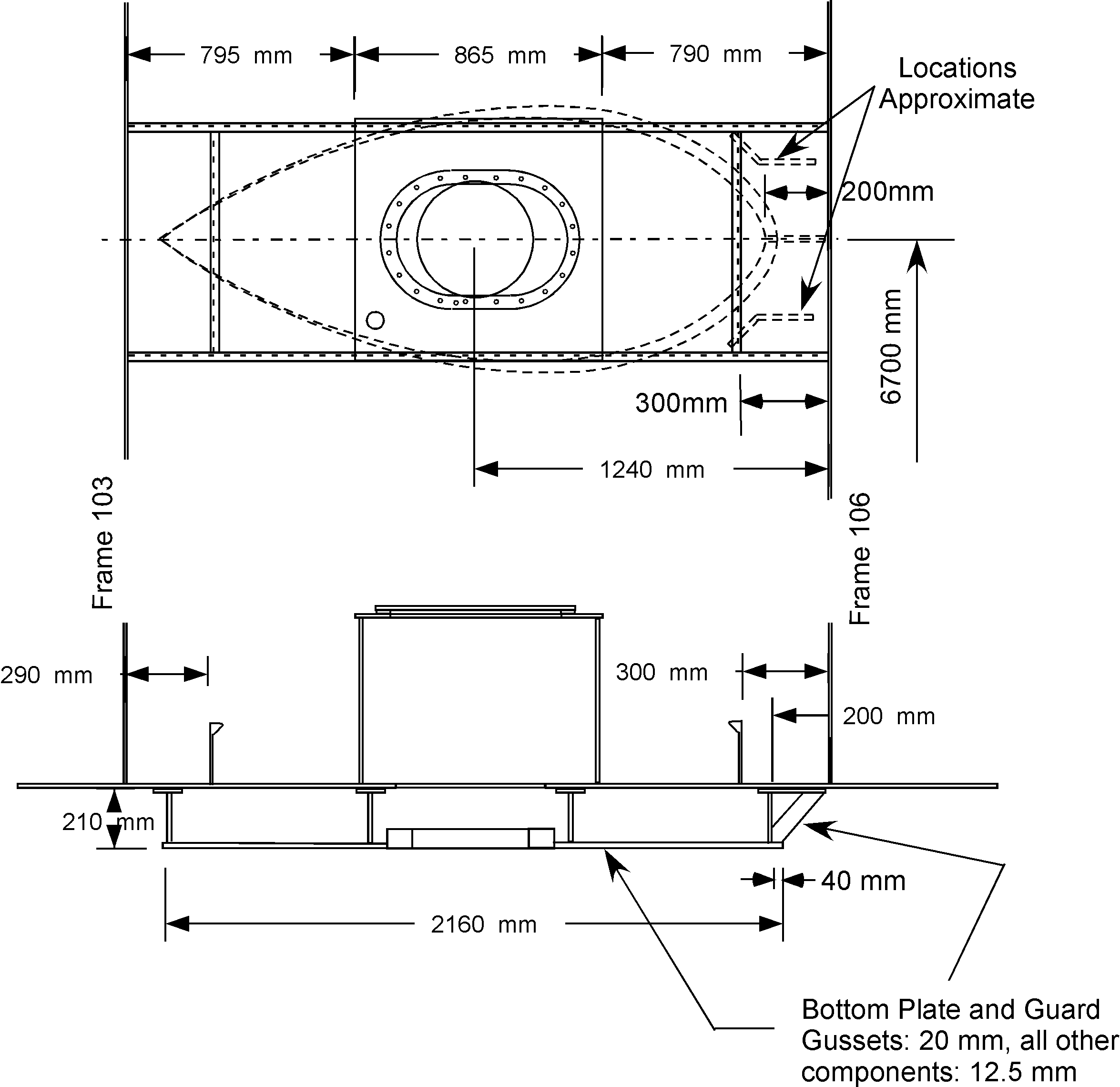
bubbles aside. The free-flooding temporary fairing was foil
shaped, 2.75 m long x 0.81 m wide x 0.20 m tall, made from 1/8"
stainless steel,
filled with expandable foam and covered with a 3/8" thick Lexan
sheet. At ~20 cm from the transducer the lexan sheet was
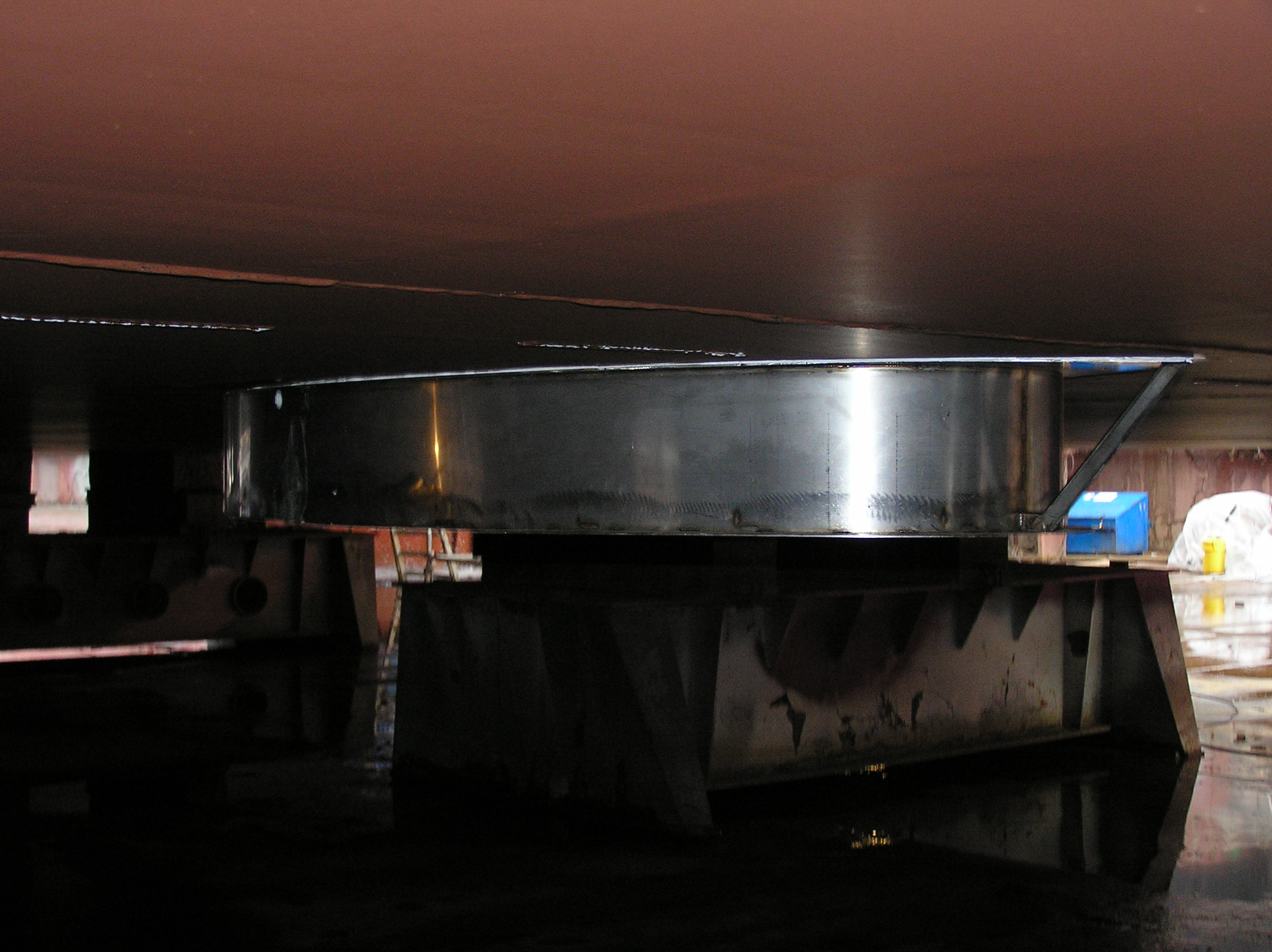
acoustically transparent to the ADCP. The drawing and photos
below show the
fairing. In the first photo the bottom of the fairing is facing
up and the conical cutout for the acoustic beams is visible. The
fairing was glued to the ship using Dow Corning 5200 marine
cement.
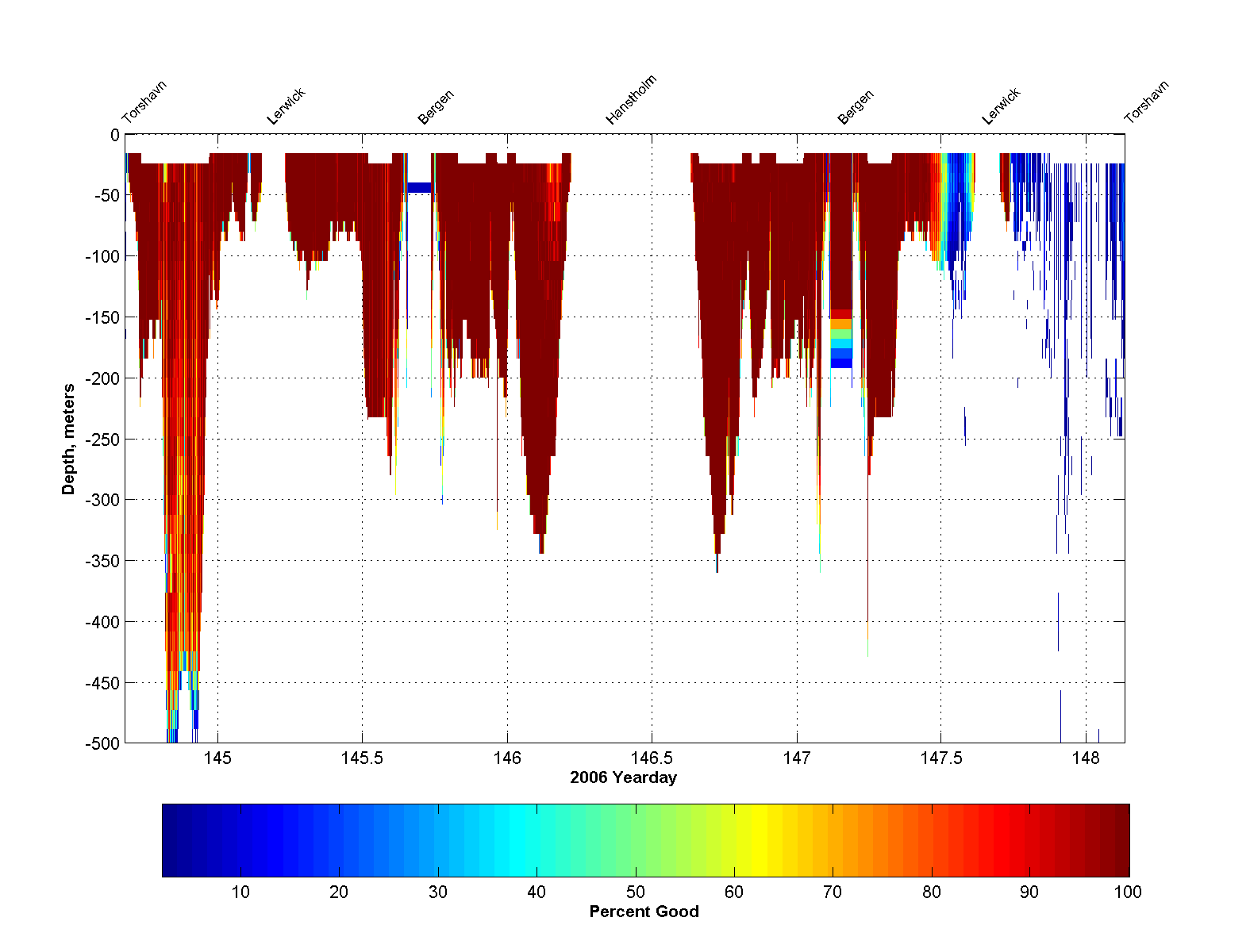
The temporary fairing stayed attached to the ship for about 10 days and
during that time we were able to collect data as the ship made a trip
from Torshavn to Europe and almost all the way back. The percent
good from that run is shown below indicating that we were getting
nearly 100% good profiles down to more than 400m in the Faroes-Shetland
Channel. The fairing seems to have fallen off just before the
ship reached Lerwick in the Shetland Islands. The contrast with
and
without the fairing is obvious and the value of a bubble fairing was
demonstrated. But gluing a fairing to the hull was not going to
be a permanent solution.
As an aside, when we finally got some data to look at it was clear that
the ADCP itself may have been defective. Shortly after the temporary
fairing was installed in May 2006, we discovered that the ADCP
instrument had developed a malfunction, probably shortly after the
first two weeks of operation. With the temporary fairing the ADCP
appeared to work but the velocities calculated from the Doppler
shifts did not seem plausible. After extensive attempts at
troubleshooting with RDIntruments technicians, we first received a
replacement deck unit as a loan from RDI, but this did not help. The
problem appeared that the problem was with the transducer. So
when the vessel was drydocked in the 3rd week of January 2007 for work
on the ship's stabilizers, the transducer was removed and returned to
RDInstruments for analysis and repair. The repaired transducer
was reinstalled when the vessel was drydocked at the end of October
2007.
With the evidence that a fairing might do the job, Smyril Lines was
amenable to the idea of a permanent, non-frangible fairing provided
that it passed inspection by Det Norska Veritas (DNV), the Norwegian
ship certification agency. Bay Marine Inc of Barrington, RI
undertook the task of designing the fairing and submitting the drawings
to
DNV. The new fairing differed from the temporary fairing in that
it was slightly narrower, the lip around the bottom was thicker, and by
the presences on three rugged bumpers installed ahead of the
fairing. The bumpers were intended to ward off debris that might
hit the fairing. The drawings were OK'd in time for another dry
dock period in late October, 2007.
While
the idea of a bubble fairing was being pursued, a second method that
would acoustically detect the presence or absence of bubbles under the
hull was being investigated. On a rather short time frame for
such a device, a protype 250kHz transducer and data logging system was
developed in time to run some tests during the week before the Norröna was
scheduled for the October dry dock period. These test were rather
uncertain but seemed to indicate that there might be a lower
concentration of bubbles out board of the transducer's initial
location. With some trepidation, the decision was made to move
the transducer and install the permanent fairing about 3.2m outboard
of the original position. The photo below shows the fairing
from the front during installation
and shows the rather substantial
bumpers. Note also that the leading edge of the lip around the
fairing was angular and not rounded.
Although we had great expectations with the new fairing, it did not
live
up to our hopes and data return was still rather poor. Better
than before, but still poor. This led to further assessment of
the problem and more consultation with experts in the fluid
dynamics around ship hulls. There were a number of possibilities
under consideration, 1) that we had moved the transducer into a region
with a greater bubble concentration and/or a thicker bubble
layer, 2) that the bumpers had altered the flow such that
vortices rolled the bubble layer underneath the fairing, or 3) that the
sharp leading edge was forming cavitation bubbles that then flowed
passed the transducer. In November 2007 the ship encountered some
unusually bad weather which caused one of the stabilizer fins to break
off and punch a small hole in the side of the ship. This led to
another dry dock period in February 2008 and we took that opportunity
to
make some relatively minor modifications to the fairing.
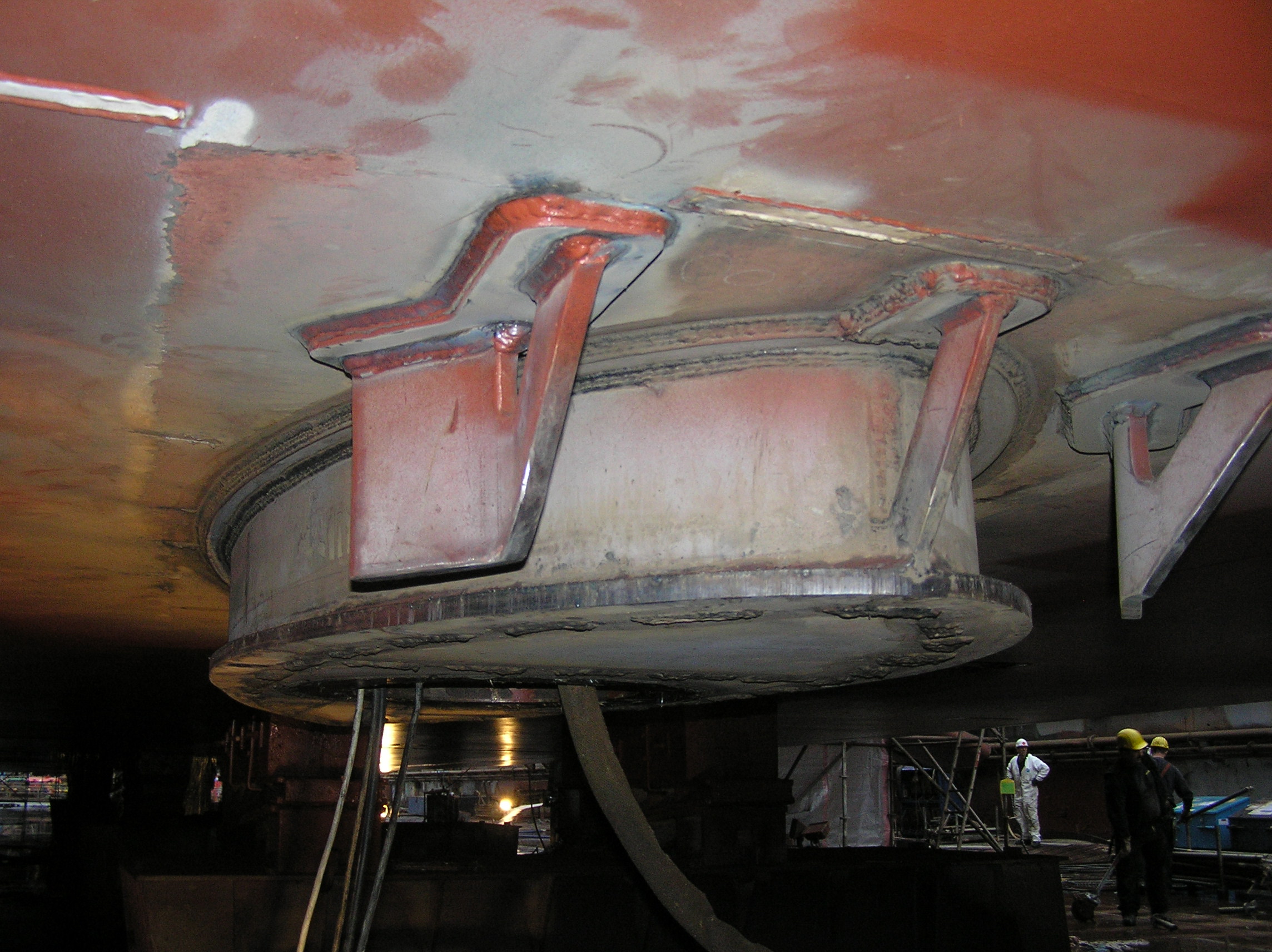
During this dry dock period we removed all three of the bumpers, added
two inches to the lip of the fairing and carefully rounded the leading
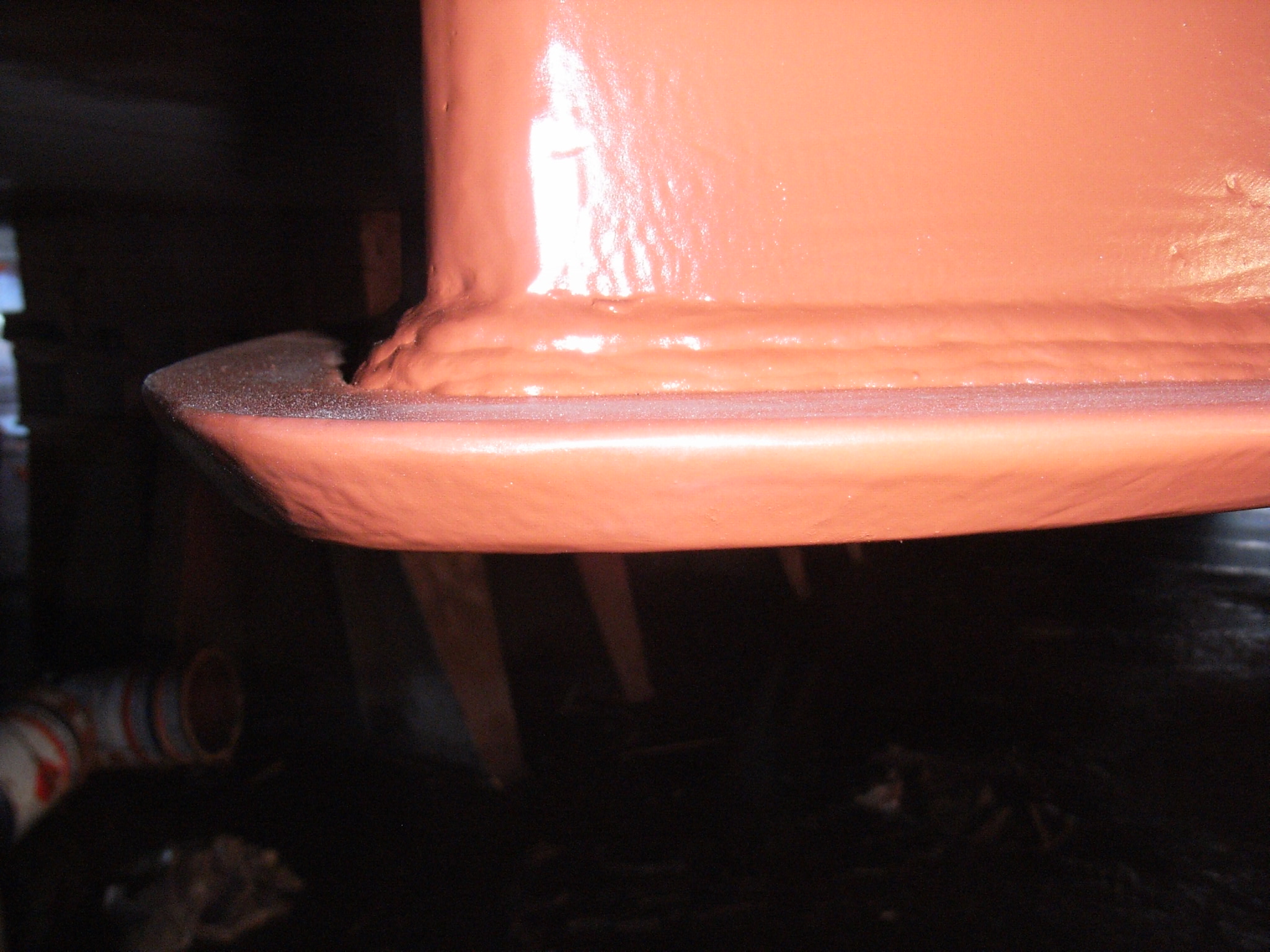
edge. The modified bubble fairing is shown in the photo below
showing a much smoother and less obstructed structure.
Results with this version of the fairing were somewhat better
and we have gathered a reasonable amount of data between the Faroes and
the mainland. Some of this improvement might simply be that the
first few months with the modified fairing have been during the late
spring and summer when the winds and waves are less. Comparing
the returns with the weather between the Faroes and Norway certainly
suggests that the returns are better when the winds and waves are low,
and less good under more adverse conditions. Also, we're still
getting poor returns over the sections the run between the Faroes and
Iceland which clearly traverses an important limb of the
North Atlantic current into the Norwegian and Greenland
Seas.
|
Norröna's
bulbous bow and
bow thrusters
 |
Temporary bubble fairing
|
Temporary bubble fairing
|
Temporary bubble fairing
|
% Good with temporary
fairing
|
1st permanent bubble
fairing
|
Permanent bubble
fairing
|
Modified bubble fairing
|
At this
stage, nearly three years into the project we had yet to completely
solve the bubble problem. The
ship was going in to the dry dock one more time in early January 2009
giving us
one more opportunity to make alterations. In anticipation of this
opportunity to make alterations our efforts were directed at
determining exactly how the bubble layer flows around and
over the
fairing, what alterations to the design might correct the problem, and
whether
there might be a more advantageous location with fewer bubbles within
the restricted
area in the ship that can support the ADCP system. There
was
a three-pronged
approach to the assessment of the bubble layer. The first was an
improved
version of the thru-hull sonar with better data logging
capabilities. The
second method was develop an underwater camera on a magnetic mount
that could
be installed by divers when the ship was in Torshavn. The camera we
used is
the latest
version of the CritterCam developed by Greg
Marshall's group at the National Geographic Society. In November
and early December of 2008 we deployed the camera at various locations
to
determine how
the bubbles were flowing over the fairing and where to best location
for
the
fairing might be. And the third approach was a serious study of the
flow
field
around the fairing using a computational fluid dynamics program from
Flow
Works, Inc. The results of these approaches are discussed below.
The updated version of the thru-hull bubble sonar
operates
at 200 kHz as before but with an improved digitization rate of 24 kHz,
decimated to a sample rate of 240 Hz, yielding a vertical resolution
under the
hull of 3 mm. The operating frequency is
determined by the acoustic impedance of the 12.5 mm thick steel hull
such that the
hull is nearly acoustically transparent and there is maximum signal
penetrating into the water. The transducer
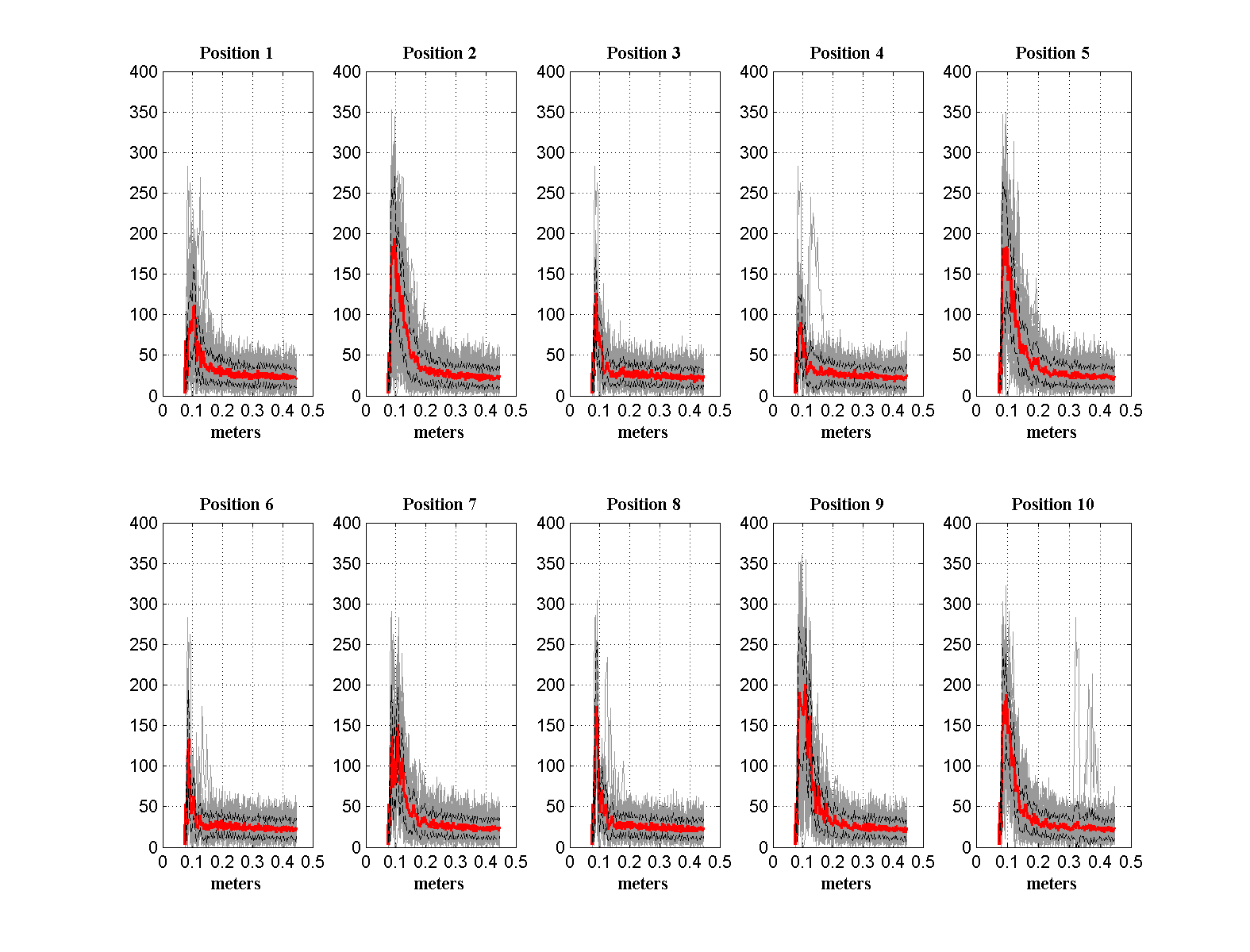
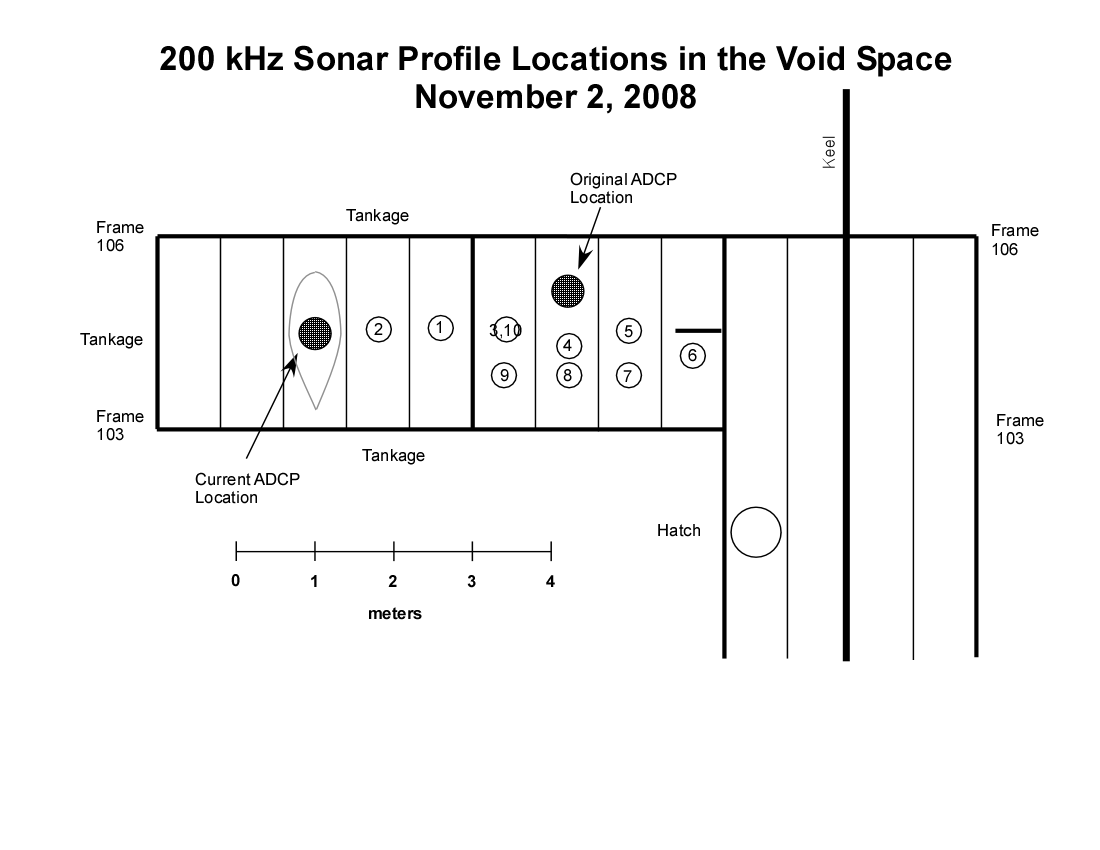
was moved to 18 places in the void space where the ADCP could be
located to see
if there was an optimal location. At
each location 100 profiles were obtained over a period of one minute
returning
120 backscatter estimates between 104 and 600 μsec
after the ping. The results that were
obtained by the sonar (see below) indicated high backscatter close to
the hull
that decayed to background at between 10 and 20 cm.
The background values corresponded closely
with those obtained when the ship was still at the dock.
Occasionally, we got high backscatter from a
few pings farther from the hull with the farthest high backscatter
return from about
40 cm. The weather during the sonar runs
was fairly benign by North Atlantic
standards,
with 10 to 18 kts of wind and average wave
heights of
8 to 11 ft as reported by the British meteorological buoy 64046. So the results do not reflect the severe
bubble conditions that typify winter seas but they do suggest that
there may be
a “usual” bubble cloud close to the hull of some 10 to 20 cm thick and
that
deeper bubbles are also possible but the sonar data are not sufficient
to
characterize those more extensive bubble clouds.

|

|
Results
from the bubble sonar showing 100
backscatter profiles at a number of locations as a function of distance
below the hull.
The
underwater camera
was an attempt to get unequivocal
evidence about the character of the bubbles under the hull. The
difficulty with this approach was to find
a camera that could operate autonomously, record the pictures
internally and be
diver deployable. It turns out that we
were not the first with requirements for an autonomous underwater video
camera. Greg Marshall’s group
at the National Geographic Society have been
developing their Crittercam for several years so
that
they could attach it to various sea animals and record their
behavior.
The latest version of the Crittercam
is remarkably compact and can record up to eight hours of video (and
audio)
data on internal solid state memory. Marshall graciously
allowed us to use one of his cameras and Eric Bergenpas
set it up so that it could record one minute of video data every four
hours for
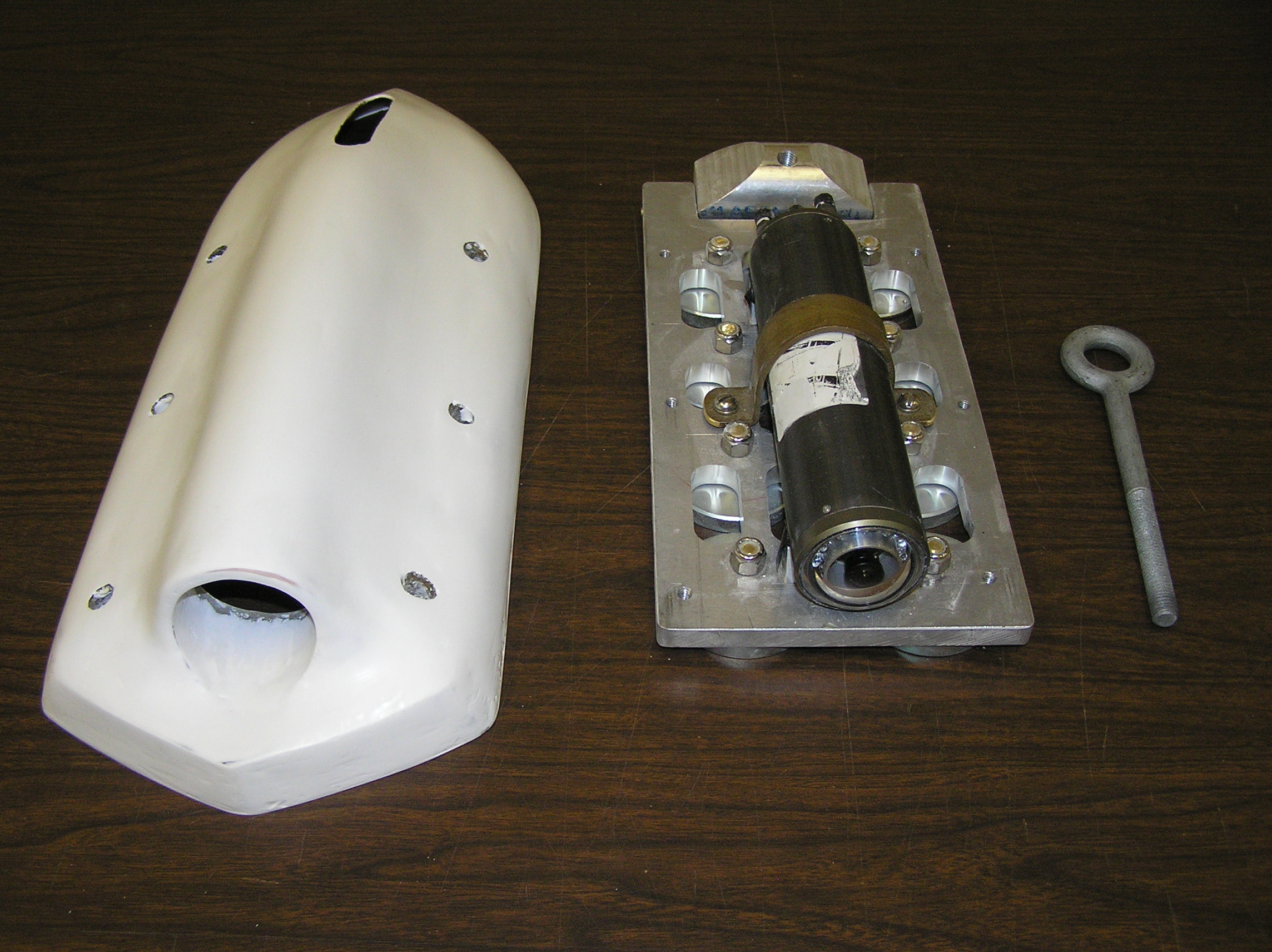
up to five days. The next step was to
develop a method to attach the camera to the hull in such a way that a
diver
could deploy it at a number of locations while remaining attached at
the Norrona’s usual cruising speed
of 20 kts. That was
accomplished using a series of
permanent magnets that together developed a grip of about 1600 lbs
together
with a lever and cam arrangement that allowed the unit to be detached
from the
hull. Then the whole camera and clamp
were housed in streamlined fairing to minimize drag.
The magnetic clamp and fairing were tested on the high speed Port
Jefferson to Bridgeport ferry with the assistance of Mark Wiggins and
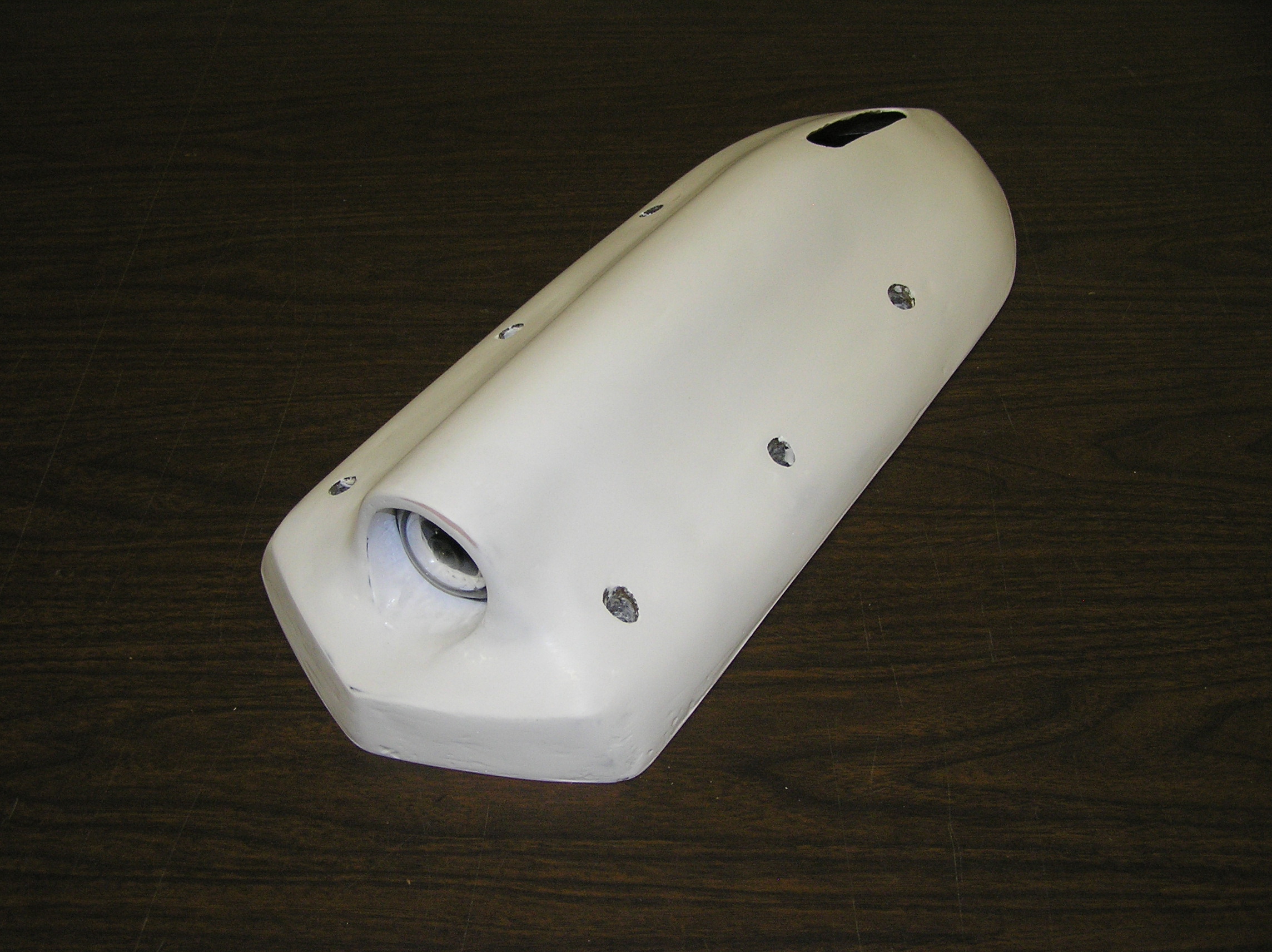
graduate student divers Brooke Rogers and Amber Stubler.
Streamline fiberglass shell, and
Crittercam on magnetic
clamp
 |
Assembled underwater camera
system
|
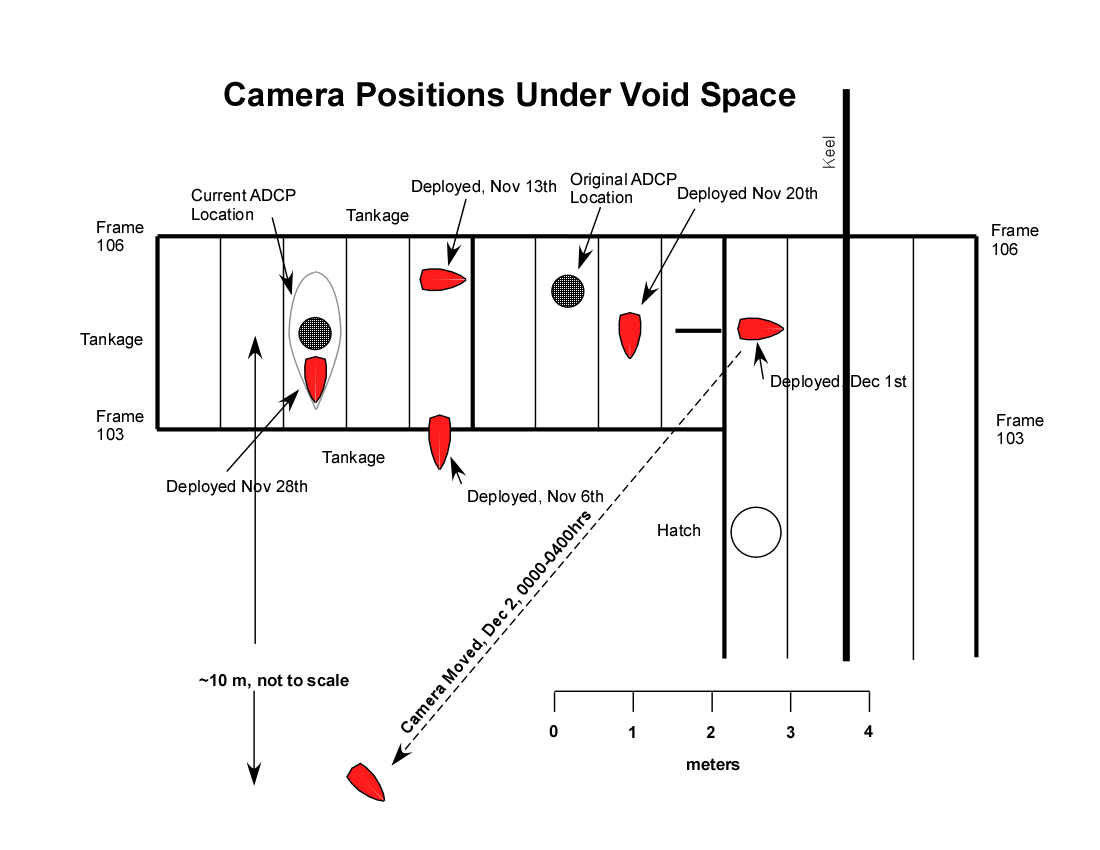
Camera positions under
void space
 |
The camera was deployed at five different locations
with the help of Ebba Mortensen of the Faroese Fisheries Institute and
Edvard Kjeld a professional diver operating in the Faores, to
study the character of the bubble clouds and to get some idea of their
spatial
distribution. That there are bubbles
under the ship is indisputable from the camera results and they are
clearly the
cause of the poor data return from the ADCP. The
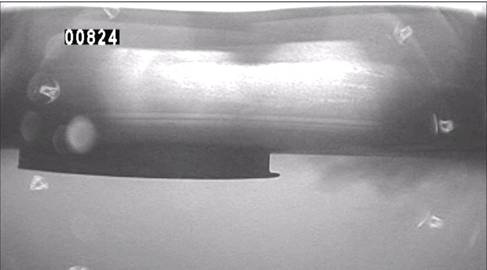
most informative results came from the videos taken
during daylight
hours when light from the surface illuminated bubble clouds from the
side. In the figure below showing the
bubble fairing
from the side, one can see the bubble cloud approaching from the right. The fairing is 21 cm high indicating that
this particular bubble cloud is roughly 30 cm deep.
This video was obtained when the winds and
sea state were relatively mild. When
the
conditions are much rougher, the camera’s vision
is often obscured by the bubbles next to the lens so our ideas about
what is
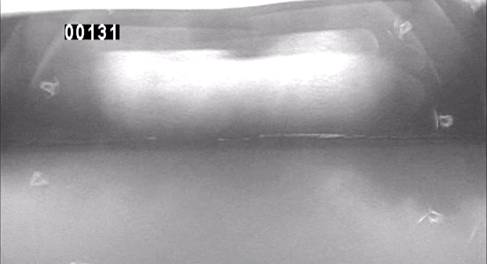
happening may be biased. The second
figure below was taken looking forward at a location closer to the
centerline
of the ship. The grey clouds visible
below the hull are the bubble clouds approaching the camera. A few frames later the camera is obscured due
to the bubbles hitting the lens. While
the bubble clouds are undoubtedly produced in the turbulent bow wave as
the
ship pitches up and down, the shape of the clouds seem quite steady for
the two
or three seconds that they show up in the videos. It
is also clear that the larger bubble
clouds are produced by the pitching of the ship as they come at the
camera at
fairing regular intervals.
 |
 |
Camera view looking at the fairing
|
Camera view looking forward
|
Clicking on the following links will bring you the
most illustrative videos for the first four deployments: #1,
#2,
#3,
and #4.
The positions of the camera for each of the videos is shown in the
figure above right. In the first video the camera is upside down
so up
is down and left is right. Overall, the combined camera and sonar
result
together with
the results from the first temporary bubble fairing suggested that
there
will be
fewer bubble problems if we moved the ADCP closer to the centerline of
the ship.
The last part of the investigation involved
computational
fluid dynamics simulations performed by Bob Fratantonio,
a graduate student in ocean engineering at URI, using Floworks
software. The questions we wanted to
resolve were: 1) was there a better overall shape to the fairing than
the
initial one, in particular would a more pointed fairing reduce the
stagnation
pressure at the leading edge of the fairing, 2) would extending the lip
forward
to 8 cm (from the current 4 cm) help
reduce
the boundary layer flow under the fairing, and 3) would vertical fins
or chines placed ahead of the fairing
cause sufficient
upwelling under the hull to bring bubble free water up against the
fairing and
transducer. Each of these questions was
addressed in succession and then finally in combination to see how the
overall
system would work.
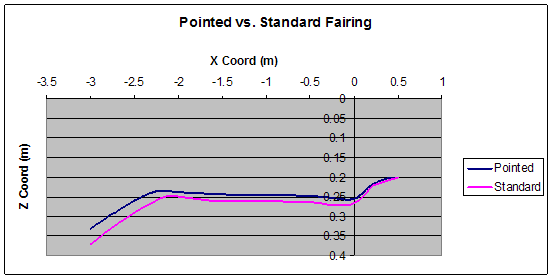
The results of altering the shape of the fairing to
be more
pointed does reduce the stagnation pressure at the nose of the fairing
slightly
and produces less of a downward deflection of particles flowing along
the
centerline as shown in the figure below. The figue
shows path of particles released ~0.5m ahead of the fairing and 0.2m
below the hull. The reduction
of the stagnation pressure on either side of the centerline is more
substantial
with a greater effect on the flow field.
The present lip on the bubble fairing sticks out
about 2 in
(5 cm) with the hope that it would reduce the tendency for water and
bubbles to
flow under the fairing. This seems to
work to some extent but we were interested to see whether increasing
the lip to
4 in (10 cm) would improve its performance. The
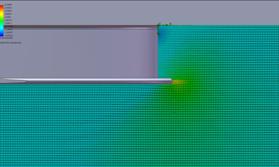
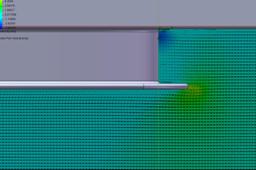
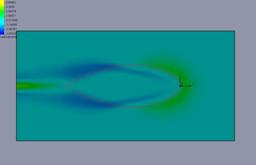
figures below show a centerline cut of the vertical
velocities using
both vectors and color. It appears that
the downward vertical velocity with the extended lip is less, but a
greater
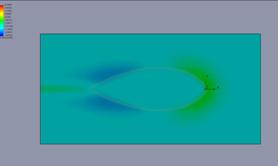
effect shows up in the vertical velocity 5 cm under the fairing. There, the extended lip produces vortices on
either side which produces an upwelling toward the face of the fairing
which
seems like it would be beneficial by bringing deeper water toward the
transducer.
 |
 |
| Z-Velocity Side Cut Plot - 2
Inch Lip |
Z-Velocity Side Cut Plot - 4
Inch Lip |
 |
 |
| Z-Velocity
5cm from Fairing Face – 2 Inch Lip |
Z-Velocity 5cm from Fairing
Face – 4 Inch Lip |
The last part of the investigation involved a study
of whether
vertical fins oriented somewhat across the flow could be designed in
such a way
that they would cause water from farther below the ship, and hopefully
with
less bubbles, to upwell toward the hull
and sweep
away the bubble laden waters. A number
of configurations were tried at various distances ahead of the fairing. The basic idea was that a pair of fins,
spreading out from the extended center of the fairing would generate a
pair of
counter-rotating vortices and upwelling along the centerline. After some experimentation, a pair of fins 20
cm tall and about 2 m long in the shape of a truncated hyperbolic
tangent
worked the best. In the figure below chines are straight fins while rails are fins in
the shape
of a hyperbolic tangent. The top of the
plot represents the bottom of the ship and leading edge of the fairing
body is
at 0m. Clearly the most effective
configuration makes use of the hyperbolic tangent rails 10 m ahead of
the
fairing which is able to draw water from 0.5 m below the ship and pull
it to
less than the height of the fairing itself, which is 20 cm deep.
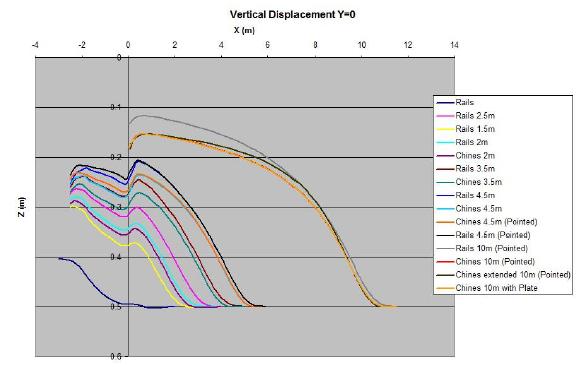
 |
| Particle
trajectories along the
centerline for a variety of fairing shapes, fin shapes and distances
ahead of
the fairing. |
In order to extend the width of the upwelling
region, the rails
extend out to 0.75 m on either side of the centerline (the fairing
itself is
about half this width) so that the upwelling covers the essentially the
whole
fairing as shown in the next figure.

 |
| Plot
of the vertical velocity about 25 cm
below the hull of the ship. Blue
is up toward the hull and yellow is downward |
The Norröna
entered the drydock at the Blohm
and Voss
repair yard in Hamburg,
Germany
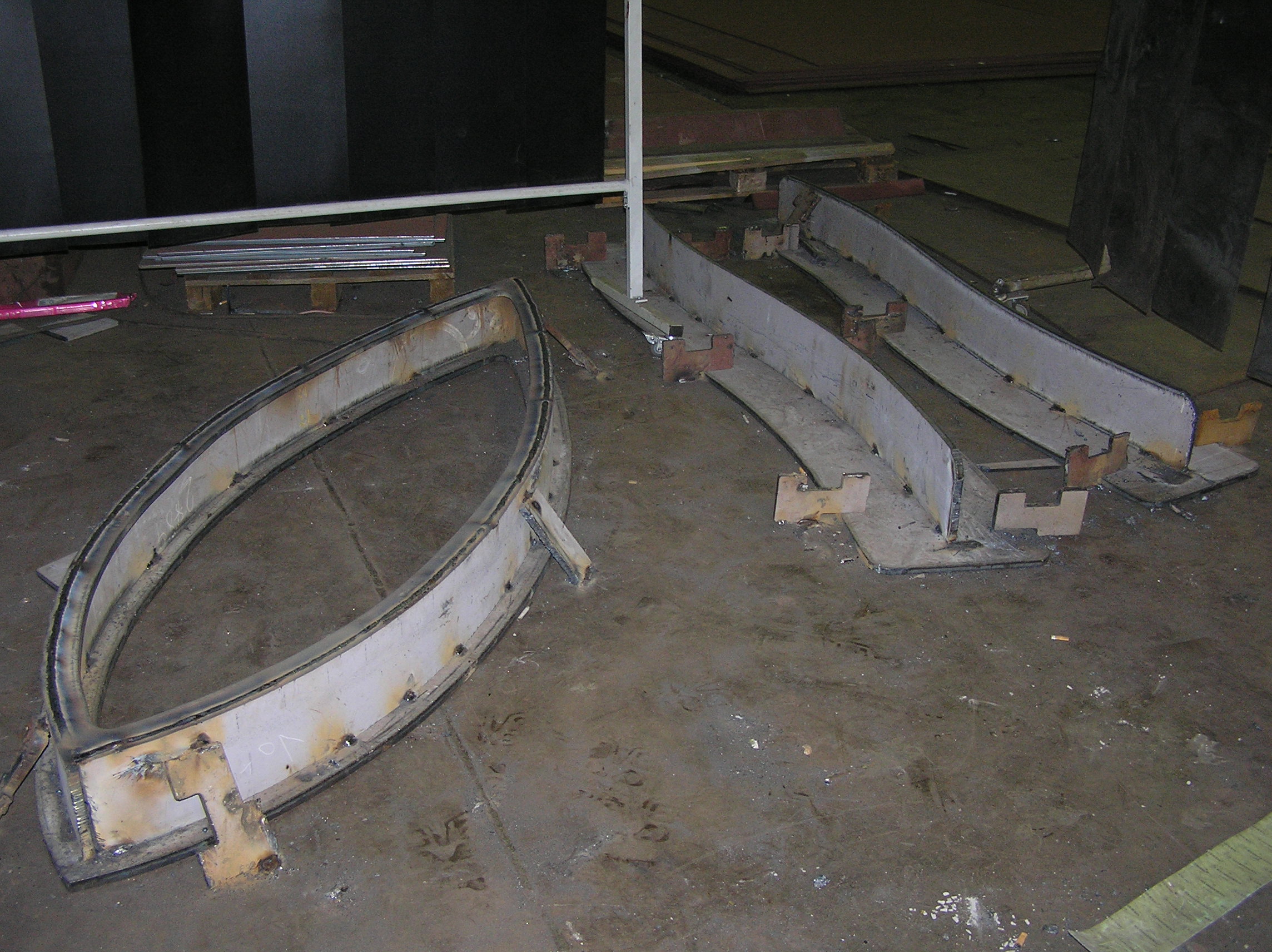
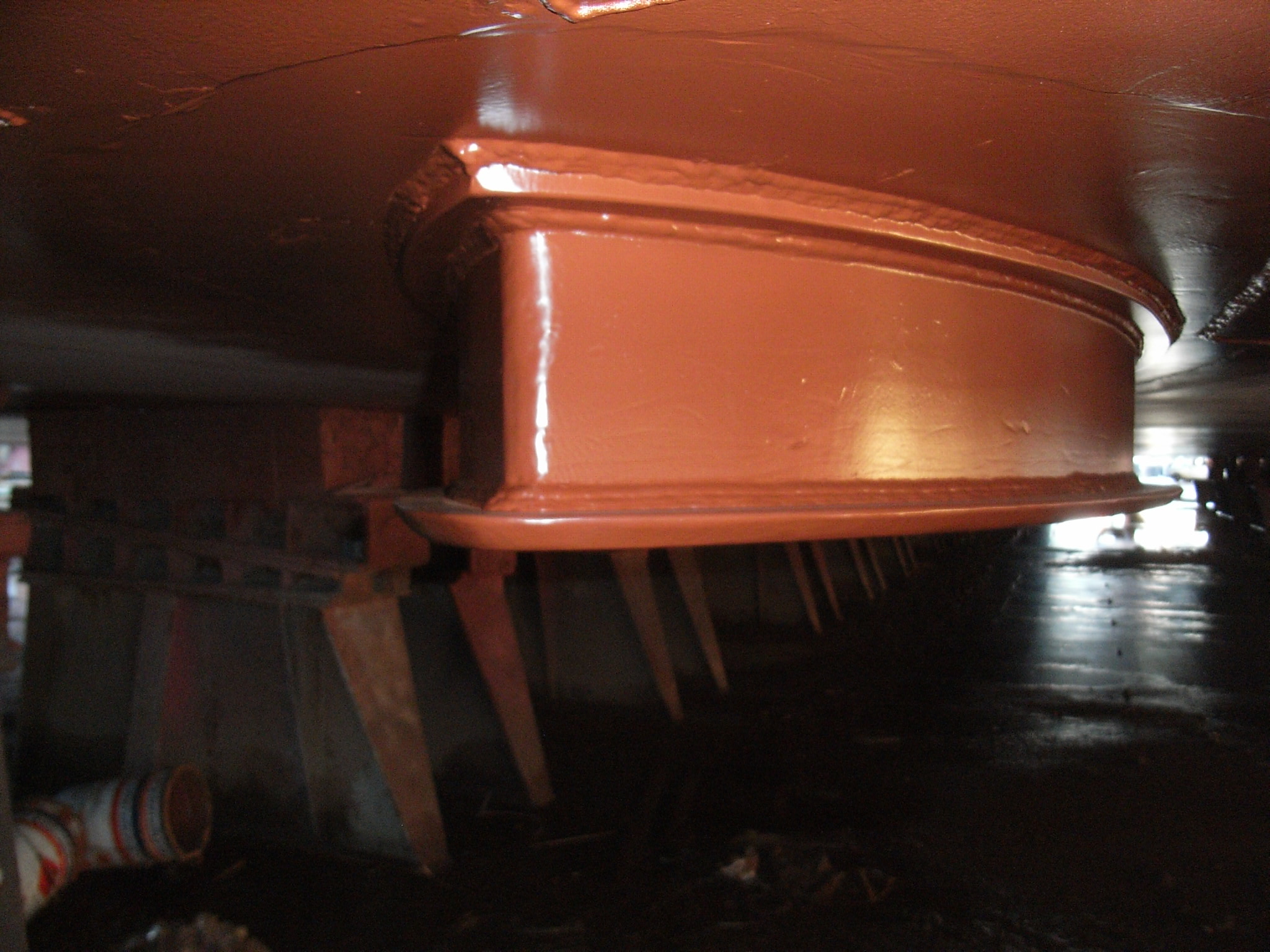
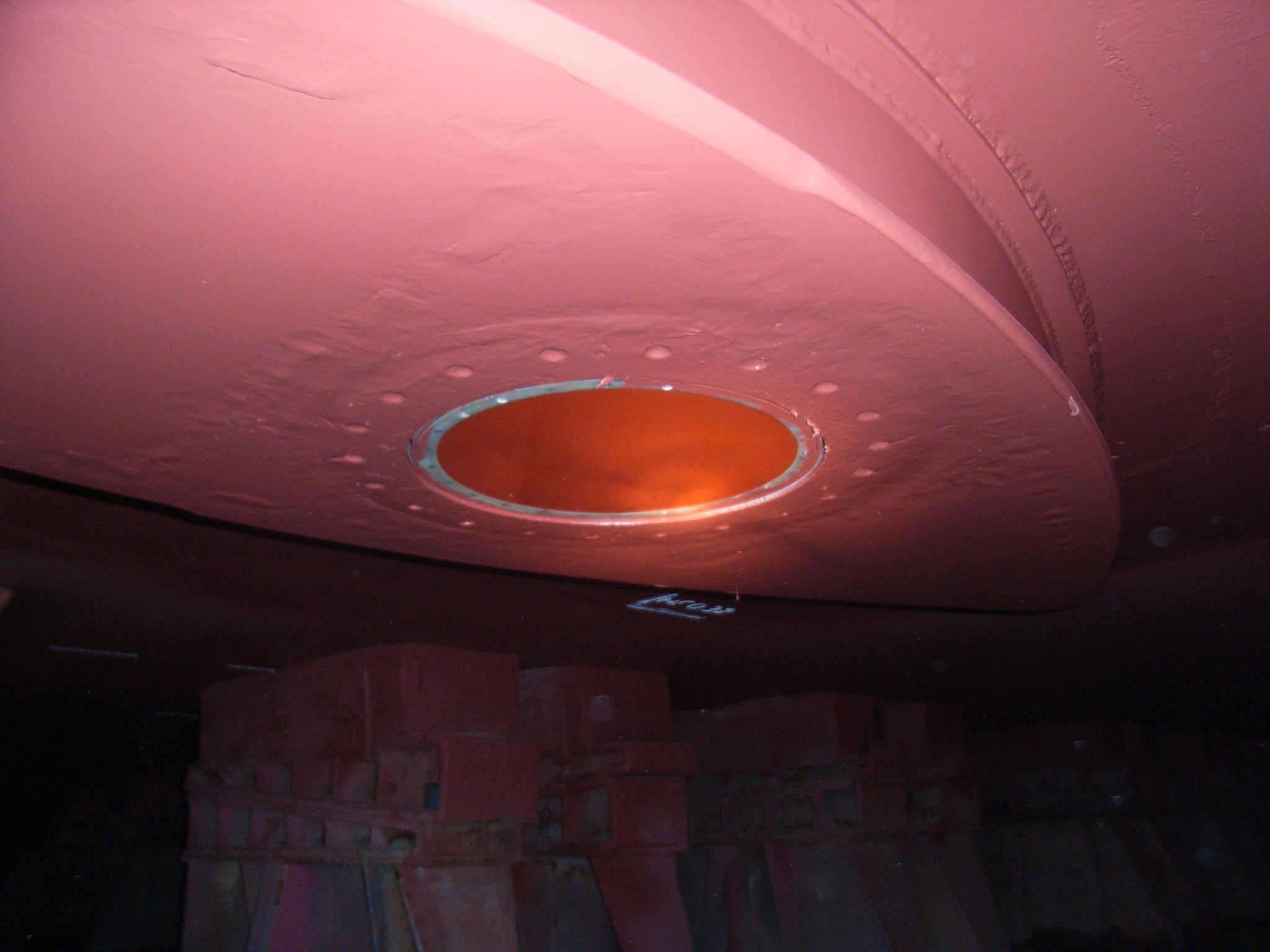
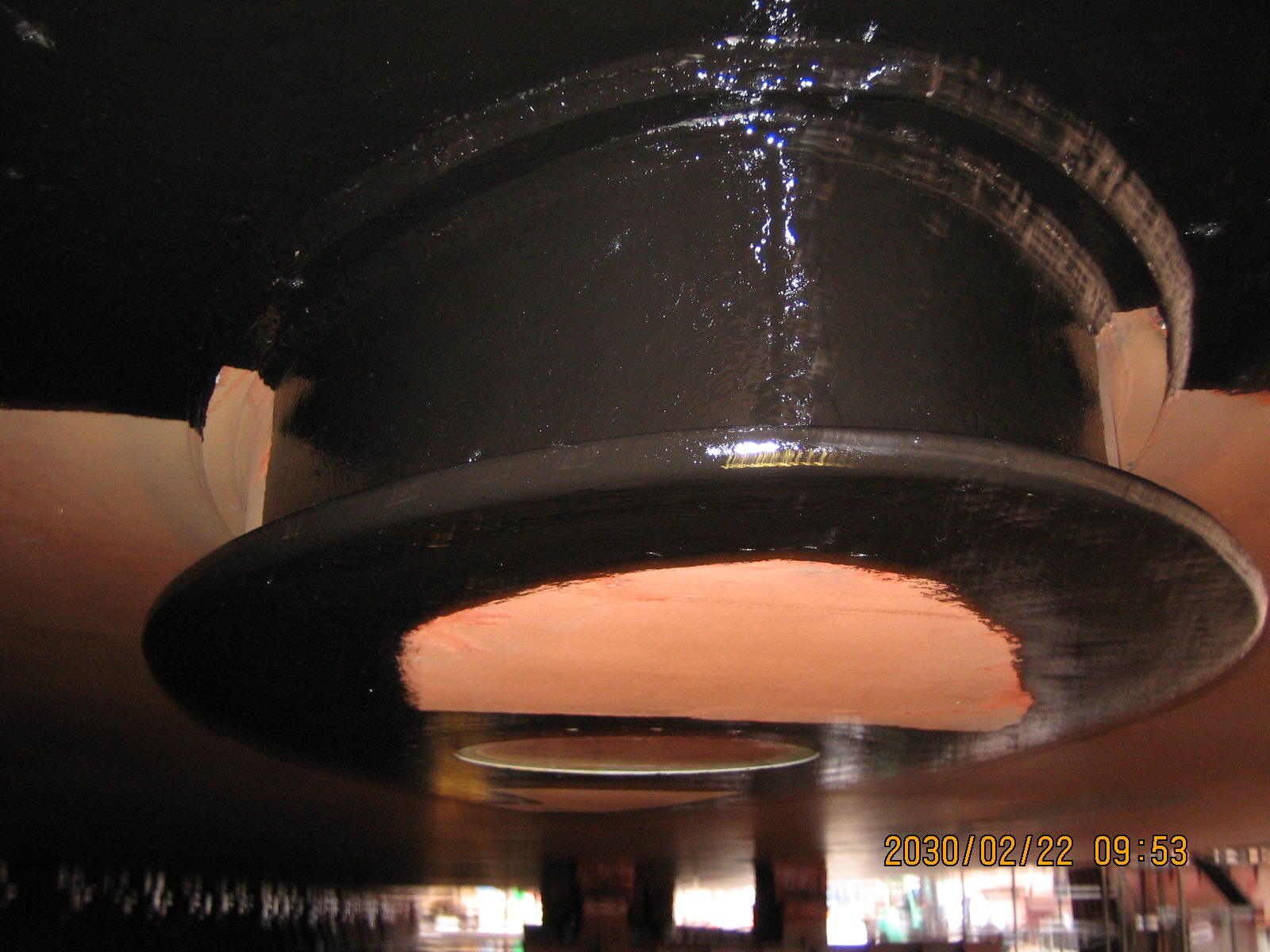
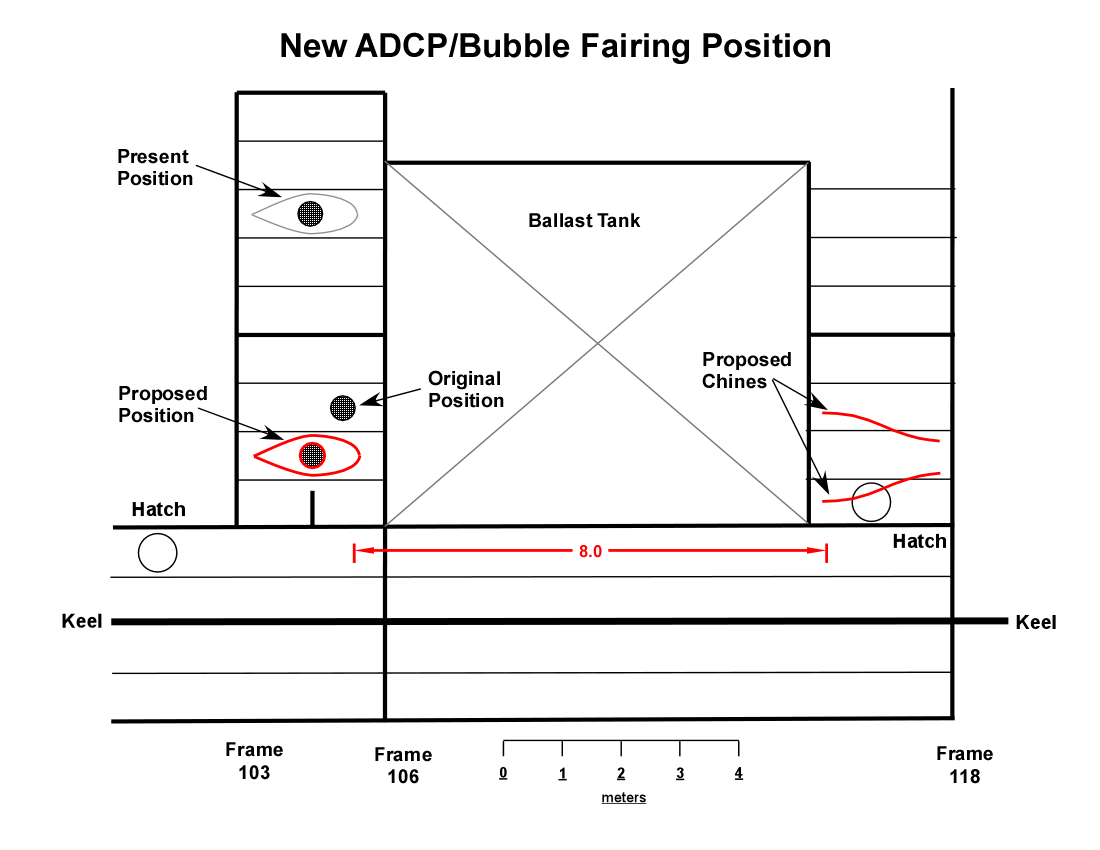
in January, 2009. At that time the existing fairing and coffer
dam were removed and a more pointed
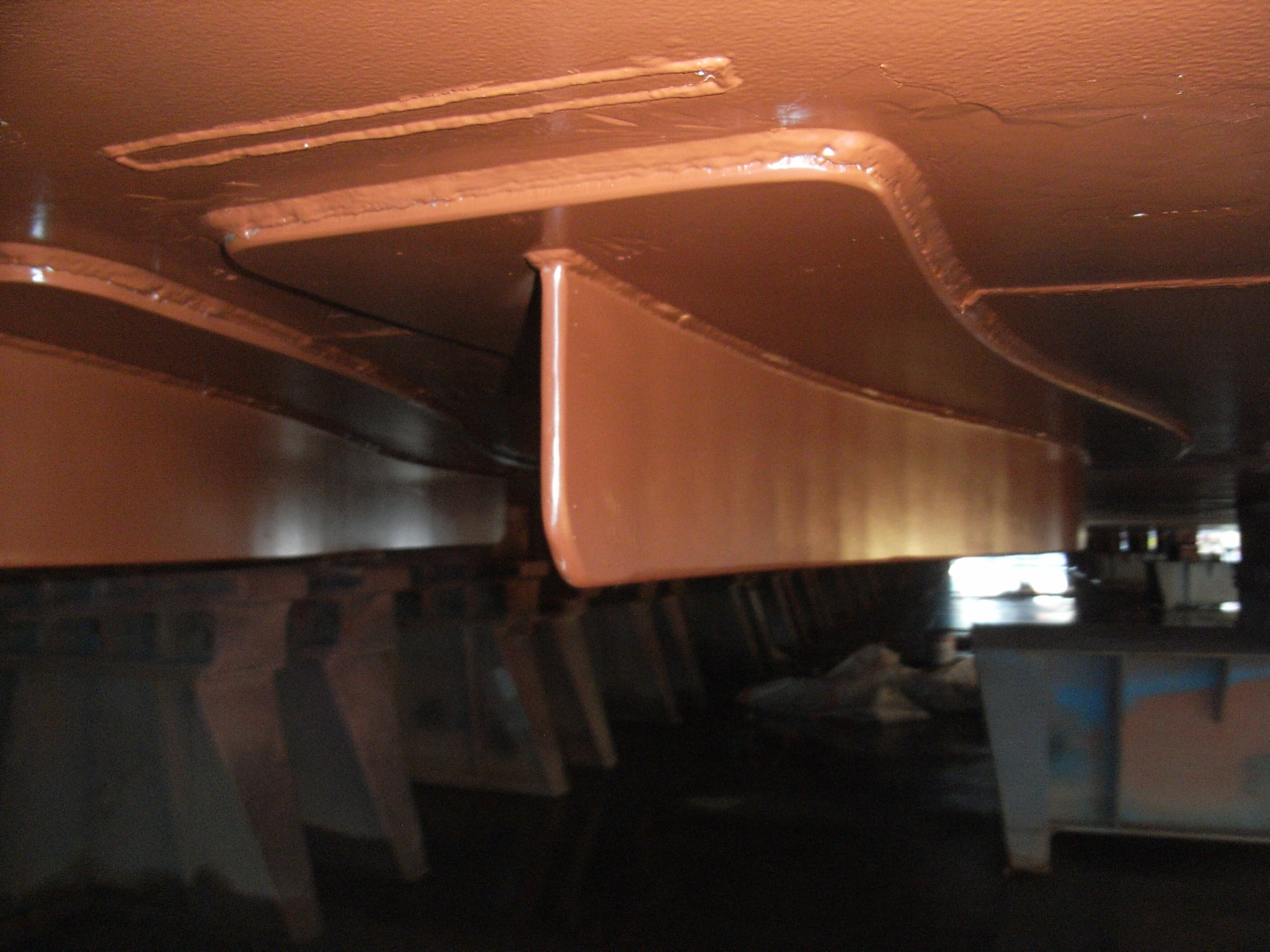
fairing with a 10 cm lip and leading hyperbolic tangent rails was
constructed. These will be installed
about 0.8 m inboard of the original ADCP location and 2.8 m from the
keel, in
the same void space as shown below. The
curved 0.2m tall rails were installed in a void space about 10m forward
of the ADCP. The pictures below show the new fairing under
construction and the new installed and painted fairing and rails.
The
ship was refloated by the last week in January, 2009 and we started to
get the first results with the new arrangement by the
mid-February. It is clear that the new system works better than
any of the previous interations but we still unable to get reliable
data on the Iceland to Faroes leg of the trip. However, the data
collection between the Faroes and Denmark across the climatically
important Shetland/Faroes Channel, especially on the eastbound leg of
the trip, has reached acceptible levels and we are encouraged that we
are headed inthe right direction.
Results
While we have been having
difficulties in collecting velocity data, the
ADCP, data collection and automated control of the system has operated
very well. At least once a week we check on the system's status
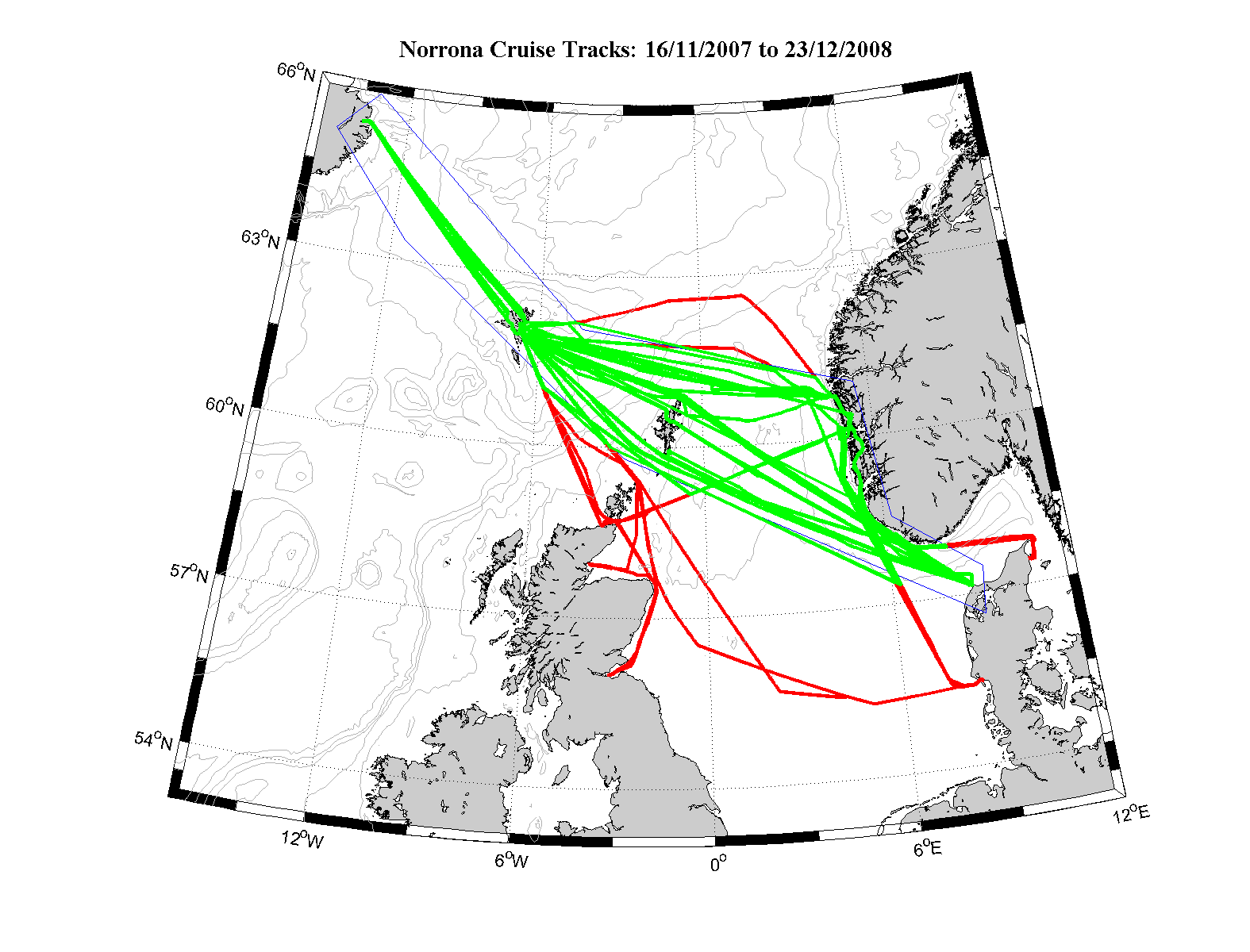
remotely and download the recent data files. The map below left
shows all the ship tracks from November 2007 through December
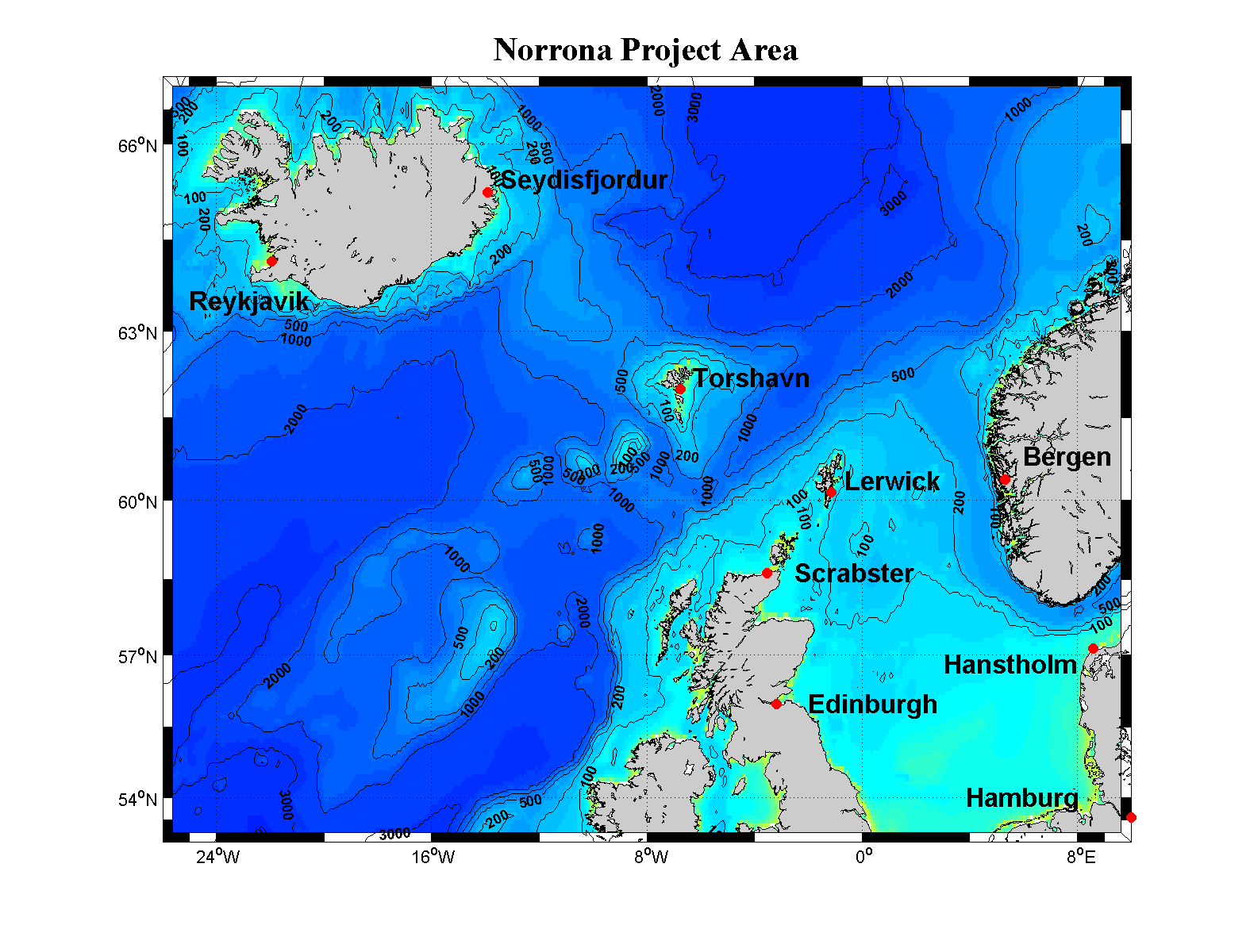
2008. As mentioned in the introduction, the Norrona's weekly
track spans the distance from Seydisfjordur in Iceland to one of three
ports in Denmark with intermediate stops in Torshavn, Bergen and
occasionally Scotland and Lerwick in the Shetlands. In the winter
months there is less demand for the Iceland portion of the route so the
Norrona's are restricted to the eastern half of the range.
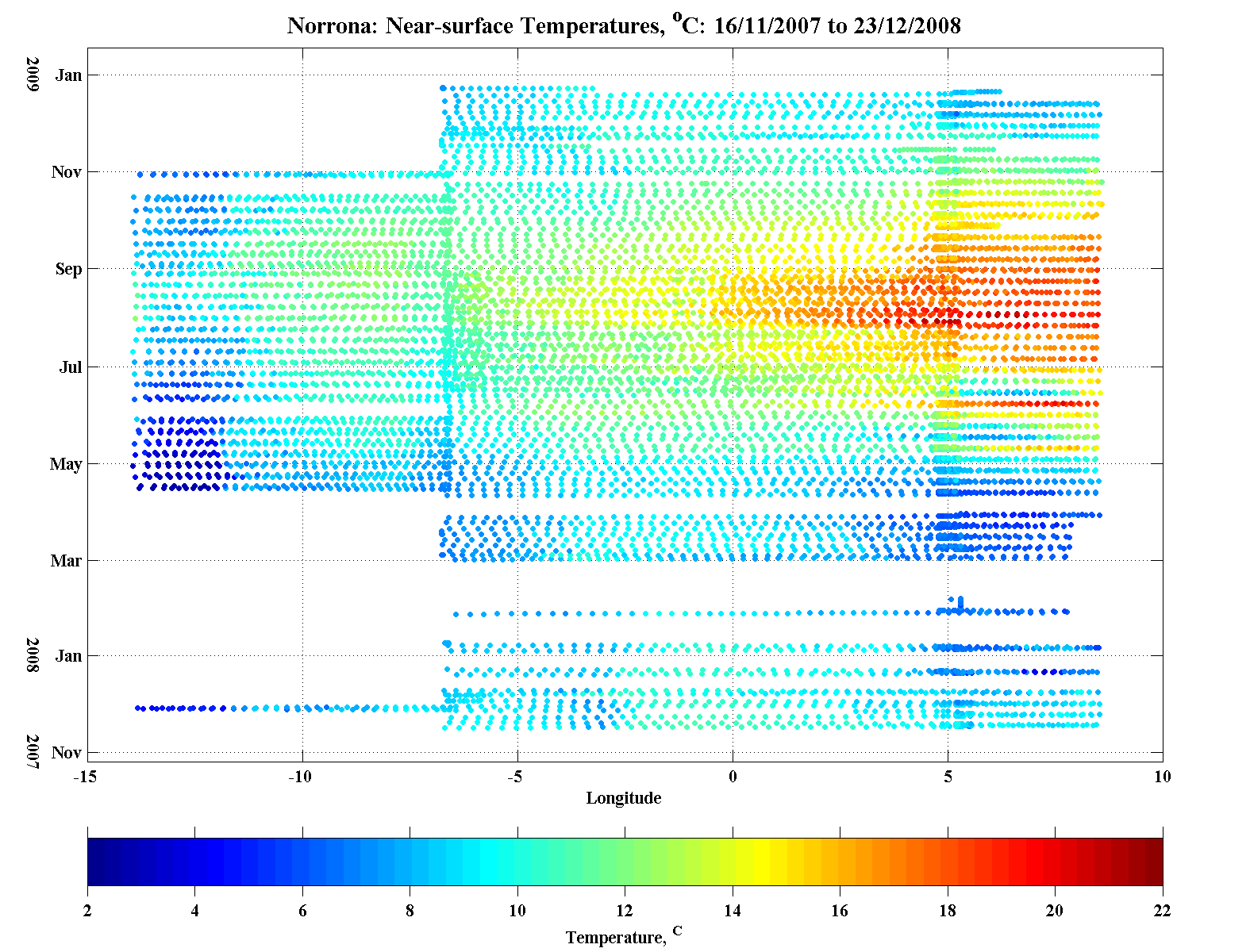
Even though the velocity data
coverage has been sporadic, the ADCP does
collect the near surface temperature data which is also downloaded once
a week. A time-distance plot of the surface temperature is shown
in the figure below right . Click on the figure to blow it up for
better viewing. The green tracks in the map show the location of
the temperature data included in the seasonal temperature evolution
plot to the right. Among other items visible in the plot is the
southward flowing cold water along the eastern Iceland coast, the
slightly cooler water flowing northward along the Faroes' west coast,
the abrupt difference in seasonal warming between the deep
Faroes-Shetland Channel and the shallower shelf of the North Sea, and
the relative delay in maximal summer temperatures between the North Sea
shelf waters and those ove the Iceland-Faroes Ridge.
These results from the
continuous temperature sensor emphasize the
power of the Norrona's route for monitoring this complex portion of the
ocean and suggest that the velocity we hope to be collecting with the
repositioned ADCP and fairing will be of immense value.
With the February 2008/February 2009
modifications to the bubble fairing, velocity
data collection has improved to
the point that we fairly consistent sections with ADCP data
across the Shetland Channel and
quite a bit more in the North Sea. What stands out from these
first sections is the high level of eddy activity in the Shetland
Channel (actually everywhere!). Even the Shetland (or Slope) Current
varies
significantly. Based on the peak speed from the nine sections so far in
the vicinity of the
Slope Current, the peak speed is about 50 cm s-1
with a 25%
standard deviation, with considerable variation in position (ie. not
tightly
locked to the slope) and direction. We do know from recent Lagrangian
work that
this area is very ‘eddy-active’ and it would appear that this activity
impinges
upon the Slope Current as well. On the eastern side of the Channel, the
flow is
always to the north as one would expect, on the Faroe Slope side the
flow is
generally to the south, but here reversals are quite common and these
may well be
due to the semidiurnal tide, which appears to be very strong on the
Faroe
Plateau (Davis et al., JPO, 2000). In short, in the center of the
channel the
velocity variability is eddy-dominated, on the Faroe shelf it is
probably
tidally dominated, and on the Shetland Slope we are less certain, both
eddy and
tidal currents contribute to the variability of the Shetland Current.
|
ADCP Data
Retrieval
This
web
page is intended to be the primary method for disseminating the ADCP
data
collected during the program. The data is concatenated into yearly
Codas3 data blocks which can be accessed by clicking on the year listed
below and filling out the form. As new data is collected it will be
added to
the current years' data blocks. The data can be retrieved by specifying
a date window and desired depth range and
vertical averaging. Remember that the minimum vertical binsize is 8
meters so nothing smaller than that will work. Also remember that
the upper most bins start around 20 meters so specifying a shallower
starting depth will produce NAN's even if some of the specified bin
contains usable data. The extracted data can be returned in either
flat-ASCII format or as MATLAB files.